It’s One of Your Essential Financial Formulas
Entrepreneurs and business leaders, this article is for you, because it’s very difficult to be competent in all subjects, and yet you have no choice. Understanding the cost of capital, for example, and mastering financial analysis is not the easiest thing for the average person. And yet they are essential for any company or investor wishing to make informed investment and financing decisions.
In this article, we will break down the main financial formulas used to calculate the cost of capital, making it easier for you to apply them to real-life scenarios. We will endeavor to make these expert concepts as accessible as possible.
Making business finance easy is our main passion and part of why we created Finotor. It’s the easiest AI- supported all-in-one accounting solution you can use to help you find your way around these financial concepts. We believe financial education in business is very important so if you’re having trouble understand certain concepts, we have resources to support your learning. Finotor is all about helping you prevent and resolve financial errors. Read below to begin learning.
What are the key points to remember?
- Definition: The cost of capital is the required return a business must earn on investments to sustain financial health and attract investors.
- The cost of capital represents the return a business must offer investors to compensate for their investment risks.
- Finance formulas like the Weighted Average Cost of Capital (WACC) are essential for calculating overall capital costs.
- The cost of equity and cost of debt can be combined to provide a comprehensive cost of capital assessment.
- Accurate use of these formulas helps businesses optimize financing strategies and make better investment decisions.
What is Cost of Capital?
To be clear, the cost of capital refers to the rate of return that a company must earn on its investment projects in order to maintain its market value and attract investment.
It is an important concept if you want to manage your investments.
Essentially, it is the price you pay to obtain financing through equity, debt or a mixture of the two.
For an entrepreneur, understanding the cost of capital enables companies to make the right financial choices and ensure that investments create value. Business leaders often think that investing directly brings a return on that investment, but they don’t understand all the aspects involved. However, a company director needs to know and master this mechanism.
We see so many poor investment choices, non-productive investments or a calculation of the return on investment that does not correspond to the real value generated.
For companies, the cost of capital is an important parameter in strategic planning. It influences budgeting, investment evaluation and financial decision-making.
It is a concept that a company director should at least understand. Ideally, an external consultant or an in-house financial department can help to provide the information needed to support the company’s strategy.
But in fact, the principle is simple. If a company’s return on investment (ROI) is lower than its cost of capital, this may indicate an inefficient allocation of capital, leading to money losses and unsustainable business practices.
Conversely, a company whose return is higher than its cost of capital can increase its value and boost shareholder confidence.
If we want to draw up a more readable formulation :
A company’s return on investment (ROI) < Cost of capital = Poor use of capital.
A company’s return on investment (ROI) > Cost of capital = Good use of capital
What are the different types of cost of capital?
To understand the concept in advance, because it is not a naturally understandable concept, there are two main types of cost of capital:
- The cost of equity – The return demanded by shareholders who invest in the company.
- The cost of debt – The interest rate paid by a company on its borrowed funds, often adjusted for tax benefits.
These two components contribute to a company’s weighted average cost of capital (WACC), which is used to assess investment opportunities.
This is where you can start thinking about your investment strategy.
Essential Finance Formulas for Cost of Capital
Weighted Average Cost of Capital (WACC)
WACC is the most commonly used formula to calculate the overall cost of capital for a business. It takes into account the proportion of debt and equity used by a company and their respective costs.
Formula: Including Net Present Value (NPV)
WACC = (E/V * Re) + (D/V * Rd * (1 – Tc))
Where:
- E = Market value of equity
- D = Market value of debt
- V = Total market value (E + D)
- Re = Cost of equity
- Rd = Cost of debt
- Tc = Corporate tax rate
The WACC formula is widely used in financial modeling, helping businesses determine the cost of financing their operations and investments. A company with a lower WACC can raise funds more cheaply, making it more competitive in its industry.
Cost of Equity (Re)
The cost of equity represents the return required by equity investors based on the perceived risk of the company.
Formula (using the Capital Asset Pricing Model, CAPM):
Re = Rf + β (Rm – Rf)
Where:
- Rf = Risk-free rate
- β = Beta (measure of the company’s risk in comparison to the market)
- Rm = Expected market return
The cost of equity calculation is essential because investors expect a return that compensates for the risk they undertake by investing in the company. A higher beta means a stock is more volatile than the market, leading to a higher cost of equity.
Cost of Debt (Rd)
The cost of debt is the effective rate a company pays on its borrowed funds, adjusted for tax savings.
Formula: Considering Interest Rate
Rd = Interest Rate * (1 – Tax Rate)
Debt financing is typically cheaper than equity financing due to tax benefits, as interest expenses are tax-deductible. However, excessive debt can increase financial risk and lead to higher costs of borrowing in the future.
Example: TechNeoLoop Inc. Evaluating an Investment Project
Background
How important it is to understand these concepts through a concrete case. It’s so difficult to put yourself in a specialist’s shoes. That’s why we present the example of TechNeoLoop Inc. in detail.
TechNeoLoop Inc. is a medium-sized technology company specializing in cloud-based software solutions, which is considering a new investment project.
This new project envisages expanding its product offering by developing an AI-powered cybersecurity tool. The company’s management team needs to assess whether this investment is financially viable and whether the potential benefits justify the costs.
Investment Details
- Initial Investment: $5 million for research, development, and marketing.
- Projected Revenue: $2 million annually over the next five years.
- Operating Costs: $500,000 per year.
- Expected Residual Value: $1 million at the end of year 5.
Cost of Capital Calculation
TechNeoLoop’s financing mix consists of:
- Debt: 40% at an interest rate of 6%.
- Equity: 60% with an expected return of 12%.
- Corporate Tax Rate: 25%.
Using the Weighted Average Cost of Capital (WACC) formula:

Where:
- E/V = 60% (Equity proportion)
- Re = 12% (Cost of Equity)
- D/V = 40% (Debt proportion)
- Rd = 6% (Cost of Debt)
- Tc = 25% (Tax rate)
WACC=(0.60×12%)+((0.40×6%×(1−25%))
So,… WACC=7.2%+1.8%=9%
TechNeoLoop’s cost of capital is 9%, which serves as the discount rate for evaluating the investment.
Net Present Value (NPV) Calculation
Using the NPV formula:

Where:
- CFt = Cash flows for each year.
- WACC = 9%.
- t = Year.
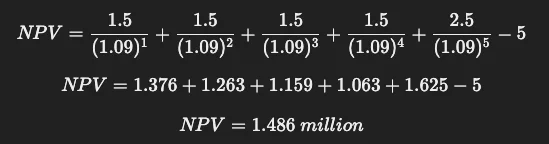
Since NPV is positive ($1.49 million$), the investment is financially viable.
Let’s now look at the internal rate of return (IRR).
By calculating the IRR (discount rate for which NPV = 0), TechNeoLoop estimates an IRR of 14%.
The IRR is therefore higher than its WACC of 9%. This confirms the project’s profitability.
So what decisions should we make?
Since the investment generates a positive NPV and an IRR higher than the cost of capital, TechNeoLoop should go ahead with the project.
Thanks to Finotor’s financial management tools, the company can efficiently track expenditure, monitor ROI and optimize tax benefits, ensuring smooth execution and sustainable profitability.
Let’s move on to your toolbox: Your Financial Glossary
So you’re an experienced entrepreneur with an investment project. You’re an entrepreneur with a well-established company and you want to confirm the feasibility and profitability of investments.
We’ve put together a financial glossary for you.
This will enable you to understand these terms so you can communicate effectively with financial professionals and make informed financial decisions.
Quick Glossary for Common Advanced Finance Terms
Accounts Receivable Turnover: This measures how efficiently a company collects payments from customers. A higher turnover means customers are paying quickly, which helps maintain cash flow.
Accounts Payable Aging: This report categorizes a company’s unpaid bills based on how long they have been outstanding. It helps businesses manage cash flow and ensure timely payments to suppliers.
Accrual Accounting: A method of recording revenue and expenses when they are earned or incurred, rather than when cash is received or paid. This provides a more accurate financial picture.
Cost Allocation: The process of assigning expenses to different departments, projects, or products based on how resources are used. This helps in budgeting and cost management.
Capital Expenditures (CapEx): Money spent on long-term assets such as buildings, machinery, or technology. These investments help a business grow and operate efficiently over time.
Enterprise Value (EV): A measure of a company’s total value, including its market value, debt, and cash. It is often used in mergers, acquisitions, and investment analysis.
Free Cash Flow (FCF): The amount of cash a company has left after covering operating costs and major investments. This is a key indicator of financial health and flexibility.
Goodwill Impairment: A reduction in the recorded value of intangible assets, such as brand reputation or acquired businesses, when they are no longer worth as much as originally estimated.
Hedging: A strategy used to protect against financial risk by using contracts or investments that offset potential losses. This is commonly used for currency, interest rates, and commodity prices.
Leverage Ratio: A measure of how much debt a company has compared to its equity or assets. High leverage can increase profits but also adds financial risk.
Liquidity Coverage Ratio (LCR): A financial rule requiring banks to hold enough liquid assets to cover short-term obligations. This ensures they can handle economic downturns or financial stress.
Operating Leverage: The degree to which a company’s costs are fixed rather than variable. A business with high operating leverage can see greater profits when revenue increases, but also higher losses if revenue declines.
Profitability Index (PI): A tool used to evaluate whether an investment is worthwhile. A PI greater than 1 indicates that the expected returns exceed the initial cost.
Return on Invested Capital (ROIC): A financial metric that measures how efficiently a company uses its capital to generate profit. A higher ROIC suggests better financial performance.
Revenue Recognition: The accounting principle that determines when revenue should be recorded. It ensures consistency and transparency in financial reporting.
Transfer Pricing: The pricing of goods, services, or intellectual property exchanged between different divisions of the same company, often across countries. It helps manage costs and tax obligations.
Working Capital Management: The process of managing a company’s short-term assets and liabilities to ensure it has enough cash flow to meet daily operations and financial obligations.
How Cost of Capital Affects Business Decisions: A Financial Analysis
The cost of capital plays a fundamental role in several aspects of business operations:
- Investment Decisions – Companies use WACC as a hurdle rate to evaluate new projects. If the expected return on a project is higher than the WACC, the project is considered financially viable.
- Capital Structure Strategy – Businesses aim to balance equity and debt financing to minimize WACC and enhance profitability.
- Risk Management – A high cost of capital indicates financial risk, prompting businesses to reconsider their funding strategies.
Making Accounting and Financial Planning Easier with Finotor’s All-in-One Solution
Understanding the cost of capital can be complex, but with the right tools, managing business finances becomes significantly easier. Finotor’s all-in-one accounting solution simplifies cost analysis and financial decision-making for small businesses.
How Finotor Helps:
- AI-Based Bank Reconciliation – Utilize artificial intelligence to automate bank reconciliation, reducing manual effort and minimizing errors.
- Add-Ons for Business – Enhance your accounting capabilities with specialized add-ons, such as business project validation tools and AI-powered business plan generators.
- Seamless Migration – Easily transition from other accounting platforms with guided migration support.
By leveraging Finotor’s powerful accounting software, small businesses can streamline financial management and make well-informed investment decisions without the complexity of manual calculations.