
Trust administration demands precise financial oversight, accurate record-keeping, and transparent beneficiary reporting. Traditional approaches like spreadsheets and manual bookkeeping often prove inadequate when managing complex trust structures, multiple beneficiaries, and regulatory compliance requirements. Modern trustees require comprehensive software solutions that streamline operations while maintaining the highest standards of fiduciary responsibility. Learn how Finotor — accounting, financial and entrepreneurial solutions can simplify trust management.
Free Trust Accounting Software for Trustees
Discover essential features and compliance best practices for trust accounting software tailored to professional trustees: automated reconciliations, audit trails, beneficiary reporting, multi-entity controls, and secure integrations.
📄 Read the full transcript — Free Trust Accounting Software for Trustees
So, here’s our game plan for today. We’ll kick things off with the trustee’s high -stakes role. Then we’ll get into the real dangers of using old -school methods. From there, we’ll pivot to the modern software solution, check out its key features, and see what automation can do. And we’ll wrap it all up by talking about the new fiduciary’s standard. Alright, first up, the trustee’s high -stakes role. Look, we’re not just talking about managing a bank account here. It’s a deep, profound responsibility. The legal term for it is fiduciary duty, and it means you have to act only in the best interest of the beneficiaries, period. In this analogy, it’s just perfect. Imagine trying to build a massive skyscraper with nothing but a little handsaw. It sounds ridiculous, right? Well, that’s exactly what it’s like trying to manage a complex trust, with all its moving parts, rules, and regulations using a simple spreadsheet. The tool just doesn’t match the job.
So, let’s get into the scary part. Let’s look at the risks of these outdated methods. We’re going to pinpoint exactly where these manual processes can go wrong, and believe me, when they go wrong, they go really wrong. The source material points to four huge risks. First, calculation errors. A single misplaced decimal or typo can mean paying out the wrong amount, which can cause massive legal headaches and destroy trust in an instant. Second, you’ve got missed payment schedules, which could literally violate the terms of the trust. Third, bad documentation, which is an absolute nightmare come audit time. And finally, all this mess can lead to serious compliance violations. Every single one of these is a landmine just waiting to be stopped on. So how in the world do you get through that minefield? Well, this is the turning point. Let’s talk about the modern software solution. This is where we stop talking about just managing risk and start talking about taking back complete control.
And just to be clear, we are not talking about some off -the -shelf accounting program. This is specialized software, built from the ground up to handle the unique, tangled web of trust administration. It’s designed to automate the grunt work and to make sure you’re staying compliant. Okay, so let’s pop the hood and look at the core features that give you this control. These are the tools that let a trustee be proactive, instead of just reacting to problems after they happen. This table lays it out pretty clearly. You can draw a straight line from the feature to the impact. Take real -time reporting, that gives you instant visibility. The impact, you can make proactive decisions, or multi -entity management. It gives you one place to see everything, which makes you way more efficient, and banking connectivity. That doesn’t just pull in transactions, it nearly eliminates manual data entry, which, as we know, is where so many errors come from.
And here’s the most important takeaway from all this. Real -time data is an absolute game -changer. It fundamentally shifts your job from putting out fires to actually steering the ship. You’re making smart, forward -looking decisions because you can see the whole picture. Right now. Okay, onto our next section. Automation and transparency. Now, you might think of these as two separate things, but they are totally connected. Automation is what slashes those human errors we were just talking about. And that new level of accuracy? That’s the very foundation you need to build and keep trust with beneficiaries. Let me give you a really powerful example. Automated distribution calculations. So instead of you sitting there with a calculator and a legal document trying to figure it all out, the system does it for you. It’s programmed with all the complex formulas, the tax rules, the specific timing, and it nails it every single time. It just completely eliminates one of the biggest risks there is.
And the benefits just ripple out from there. All of a sudden, you’re spending way less time on processing, your accuracy goes through the roof, compliance is being monitored 24 -7 in the background, and you have a perfect automatic audit trail for every single thing that happens. And how does this make things more transparent for beneficiaries? Well, first, the system spits out professional, easy -to -understand statements automatically. Second, beneficiaries can get their own secure login to see the information that’s relevant to them. And third, all the important documents are in one central, organized place. No more confusion. Which brings us to our final section, where this all comes together. Let’s talk about the new fiduciary standard. We’re going to put the old way and the new way side by side, and the difference is, well, you’ll see.
Just look at the difference here. It’s a total transformation. Instead of typing everything in by hand, transactions flow in automatically. Instead of a calculator and a piece of paper, you have AI -powered automation doing the math. Reporting goes from a custom, time -consuming chore to a quick, template -based process. And compliance isn’t a checklist you review once a quarter, it’s a system of built -in alerts. Honestly, it’s a night and day difference. So at the end of the day, this whole shift, it’s not just about getting shinier, better tools. It’s about being able to uphold a higher standard of care. It’s about using the best technology available to truly honor that profound responsibility we talked about at the very beginning. And that leaves us with one final thought. As literally every part of the financial world goes digital as it gets faster and more automated, what do you think is the biggest risk of choosing not to evolve with it? Something to think about. Thanks for joining me today.
If you would like to view the video on YouTube: Trust Accounting Software: Features, Compliance & Best Practices (2026 Guide)
Understanding Trust Accounting Software Requirements
Trust accounting differs significantly from standard business financial management. Trustees must track multiple revenue streams, manage distributions across various beneficiaries, maintain detailed audit trails, and ensure compliance with legal standards. The complexity increases exponentially when managing multiple trusts or handling diverse asset portfolios.
Manual processes create significant risks including:
- Calculation errors in distributions
- Missed payment schedules
- Inadequate documentation practices
- Potential compliance violations
These challenges underscore the importance of selecting robust accounting platforms specifically designed to handle trust administration complexities. For those starting with personal and business finances, understanding the requirements is a crucial first step.
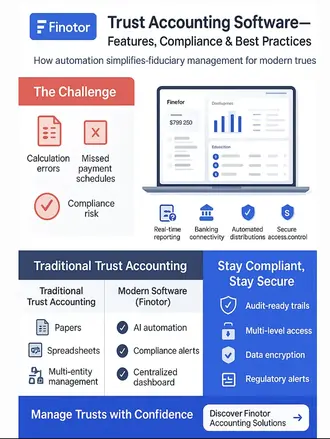
Infographic: Trust accounting software features compliance best practices
Essential Features for Effective Trust Management
Modern trust accounting platforms must deliver comprehensive functionality across multiple operational areas. Automated financial tracking ensures accurate recording of all trust transactions, from initial funding through final distributions. This automation reduces human error while creating detailed audit trails necessary for regulatory compliance. You can see similar automation benefits in Sole Proprietorship Accounting Software.
Core Functionality Requirements
| Feature | Benefit | Impact |
|---|---|---|
| Real-time reporting | Instant visibility into trust performance | Proactive decision-making |
| Multi-entity management | Consolidated oversight of multiple trusts | Operational efficiency |
| Banking connectivity | Automatic transaction imports | Reduced manual data entry |
Real-time reporting capabilities provide trustees with instant visibility into trust performance, beneficiary accounts, and distribution schedules. These dynamic dashboards enable proactive decision-making and support transparent communication with beneficiaries and legal representatives.
Multi-entity management becomes crucial when trustees oversee multiple trusts or complex family structures. Consolidated reporting across various trusts while maintaining individual account integrity requires sophisticated software architecture that many basic accounting tools cannot provide. See how selecting the ideal accounting software for your firm improves multi-entity management.
Streamlined Operations Through Integrated Solutions
Comprehensive trust management platforms integrate multiple operational components into unified systems. Banking connectivity enables automatic transaction imports, reducing manual data entry and ensuring real-time financial accuracy. This connectivity also facilitates faster reconciliation processes and identifies discrepancies immediately. Integration examples include Connect Stripe to Finotor and automate your Accounting.
Automated Processing Capabilities
Intelligent expense categorization uses advanced algorithms to classify transactions automatically, ensuring proper allocation between trust administration costs, beneficiary expenses, and investment-related fees. This automation significantly reduces time spent on routine bookkeeping tasks.
Automated distribution calculations eliminate manual computation errors while ensuring beneficiaries receive accurate payments according to trust terms. These systems can handle complex distribution formulas, tax considerations, and timing requirements without constant manual oversight.
Key automation benefits include:
- Reduced processing time
- Improved accuracy rates
- Consistent compliance monitoring
- Enhanced audit trail generation
Enhanced Beneficiary Communications and Transparency
Trust administration requires regular communication with beneficiaries regarding account status, distributions, and trust performance. Modern platforms provide automated beneficiary reporting that generates professional statements, tax documentation, and performance summaries without manual intervention. You can find examples in Invoice Smarter: Smile and Get Paid!
Document Management and Reporting
Secure document management centralizes all trust-related documentation, making information easily accessible to authorized parties while maintaining appropriate security protocols. This centralization eliminates the risk of lost documents and ensures consistent record-keeping across all trust activities.
Customizable reporting templates allow trustees to generate specific reports for different stakeholder needs, whether for legal proceedings, tax preparation, or routine beneficiary updates. This flexibility ensures appropriate information delivery to each audience.
Communication Workflow Optimization
Advanced platforms streamline beneficiary communications through:
- Automated statement generation
- Secure portal access for beneficiaries
- Customizable notification systems
- Professional document templates
Compliance and Risk Management
Trust administration involves significant regulatory requirements and fiduciary responsibilities. Comprehensive accounting platforms include built-in compliance monitoring that tracks regulatory requirements and alerts trustees to potential issues before they become problems. Explore how Understanding VAT Obligations and Understanding VAT: What It Costs integrates into compliance checks.
Detailed audit trails document every system action, creating comprehensive records necessary for legal proceedings or regulatory examinations. These trails provide protection for trustees while demonstrating proper fiduciary conduct.
Security and Access Control
| Security Feature | Function | Trustee Benefit |
|---|---|---|
| Multi-level access | Controls user permissions | Protected sensitive data |
| Encryption protocols | Secures data transmission | Regulatory compliance |
| Backup systems | Prevents data loss | Business continuity |
Access control and security features ensure sensitive trust information remains protected while allowing appropriate parties necessary access. Multi-level security protocols protect against unauthorized access while facilitating legitimate business operations. Similar robust security exists in Finotor — accounting, financial and entrepreneurial solutions.
Scalability for Growing Trust Portfolios
Professional trustees often manage expanding portfolios requiring scalable solutions. Multi-client capabilities enable trust professionals to manage numerous client relationships within single platforms while maintaining complete segregation of sensitive information.
Advanced Workflow Automation
Advanced workflow automation handles routine tasks like recurring distributions, compliance notifications, and beneficiary communications without constant manual intervention. This automation allows trustees to focus on strategic decision-making rather than administrative tasks.
Integration capabilities connect trust accounting platforms with investment management systems, legal software, and tax preparation tools, creating comprehensive operational ecosystems that eliminate data silos and reduce duplicate entry requirements. Similar integrations are found in Finotor — Accounting for Entrepreneurs.
Scalability features include:
- Multi-client management
- Automated workflow processing
- Third-party system integration
- Customizable reporting frameworks
Modern Solutions for Trust Administration Excellence
Finotor provides comprehensive accounting and financial management capabilities designed to address the unique challenges facing modern trustees. The platform combines AI-powered automation with robust financial tools to create efficient, accurate, and compliant trust administration processes.
Rather than juggling multiple software solutions or struggling with inadequate spreadsheet systems, trustees can access integrated functionality covering all operational requirements. From initial trust setup through final distributions, comprehensive platforms provide the tools necessary for professional-grade trust administration.
Comprehensive Platform Benefits
| Capability | Traditional Method | Modern Platform |
|---|---|---|
| Transaction tracking | Manual spreadsheet entry | Automated bank connectivity |
| Distribution calculations | Calculator and paper | AI-powered automation |
| Beneficiary reporting | Custom document creation | Template-based generation |
| Compliance monitoring | Manual checklist review | Built-in regulatory alerts |
Experience how modern technology can transform your trust administration operations. Explore Finotor Accounting Solutions — All Features, Prices & Plans for comprehensive solutions designed specifically for fiduciary professionals who demand accuracy, efficiency, and complete regulatory compliance in their daily operations.