
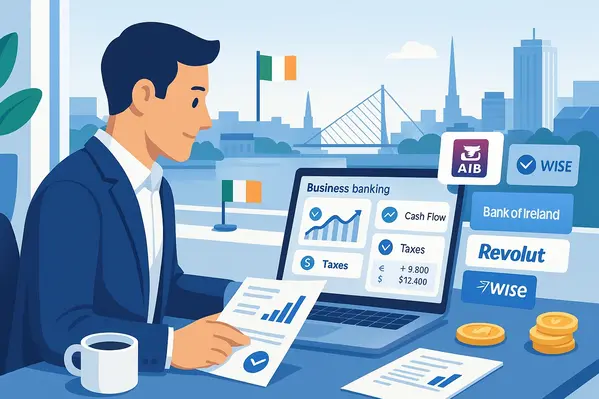
No time to read? 🕒 Separating business and personal finances isn’t just legal—it’s strategic. A dedicated Irish business account streamlines taxes, boosts credibility, and unlocks growth. ⚖️ Mixing coffee purchases with client payments? 🧾 Chaos! Startups save 18-24 months with fee-free offers from AIB or Bank of Ireland! 💼✨
Struggling to choose the right business bank account Ireland as a startup founder? 🤔 Discover a clear roadmap for setting up a business bank account Ireland, tailored for entrepreneurs navigating Ireland’s financial landscape. From comparing traditional banks like Bank of Ireland to agile fintechs like Revolut or Wise, this guide reveals pro tips to streamline paperwork, avoid hidden fees, and secure a solution that aligns with your growth goals. 🚀 Whether you’re a non-resident director or scaling globally, learn how to tackle KYC verification, leverage multi-currency options, and unlock startup-friendly offers—ensuring your Irish business banks like a pro from day one! 💼
- Why You Need a Separate Business Bank Account in Ireland 🇮🇪
- The essential documents you’ll need to get started
- The step-by-step process to open your account
- Traditional banks vs. modern fintechs: a comparison
- Special considerations for non-resident directors
- Understanding the fees and charges 💰
- Practical tips for a smooth application
Why You Need a Separate Business Bank Account in Ireland 🇮🇪
Starting a business in Ireland is an exciting journey! 🚀 One of the first hurdles? Opening a business bank account ireland. But why is this step non-negotiable? Let’s unpack the “why” so you’re crystal clear before diving into the “how.” 💡
Mixing personal and business finances? Big red flag! 🔴 A dedicated business account eliminates chaos, offering real-time insights into cash flow, expenses, and revenue. For non-residents, this separation ensures compliance with Irish tax laws from day one. Plus, it’s a legal must-have for limited companies—no room for shortcuts here! 📉
Picture tax season without a business account. 🧾 Nightmare? Absolutely. With separate records, filing returns becomes stress-free for you or your accountant. The Revenue Commissioners demand clean financial trails, and a dedicated account ensures you’re audit-ready. Pro tip: Tools like Citizens Information highlight this as a top compliance priority. Failing to document expenses properly could lead to rejected tax claims—ouch! 📉
Want to stand out? 🌟 A business account screams professionalism. Sending an invoice with your company’s name and bank details versus a personal card instantly builds trust. For non-residents, this proves reliability to Irish partners—no more “side hustle” vibes! 💼 For example, a German entrepreneur managing VAT payments through an Irish business account avoids confusion and strengthens client confidence. 🇩🇪➡️🇮🇪
Thinking long-term? Growth starts here. 💪 Lenders stress that clear financials are key for loans or investor pitches. A business account isn’t just a tool—it’s your foundation for scaling. Even fintechs like bunq emphasize how organized finances attract funding. Ready to tackle the paperwork? Let’s roll! 🚀
The essential documents you’ll need to get started
Ready to apply? Let’s get your paperwork in order first. 📋 Preparing the right documents streamlines the process and avoids delays. The exact requirements vary slightly depending on your business structure, so let’s break it down clearly.
Core documents for all applicants
Every business owner, director, or authorized signatory must provide personal identification and address verification. For identity proof, valid documents include a passport or a driver’s license. Address verification requires recent documents like utility bills or bank statements dated within the last 6 months. Banks may also request certified copies of these documents, so it’s wise to have them ready. This applies to all business types, ensuring compliance with Ireland’s anti-money laundering regulations. Double-check with your bank if digital scans suffice for initial applications.
Specific documents by business type
Sole traders enjoy a simpler process. You’ll need proof of business name registration if operating under a trade name (e.g., “GreenTech Solutions” instead of your personal name). Additionally, provide your PPSN (Personal Public Service Number) or Tax Reference Number. A Tax Clearance Certificate from Revenue Commissioners can verify your tax compliance. For example, a freelance graphic designer using “Creative Designs Ltd” must submit these documents alongside personal ID and address proof.
Limited companies face stricter requirements. Prepare:
- Certificate of Incorporation from the Companies Registration Office (CRO).
- The company’s Constitution (combining Memorandum and Articles of Association).
- A signed list of all directors and beneficial owners, including their roles, addresses, and birthdates.
- Proof of registration with the Central Register of Beneficial Ownership (RBO), which combats financial crime by tracking ultimate ownership. For instance, a tech startup with foreign investors must confirm all shareholders owning 25%+ stakes are listed here.
The RBO ensures transparency, a key requirement for Irish companies.
Partnerships require a Partnership Agreement outlining each partner’s responsibilities. All partners must submit personal ID and address proof. For example, a law firm partnership needs the agreement signed by all parties, plus individual passports and utility bills for verification. Banks may also ask for the partnership’s Tax Reference Number to confirm compliance.
Pro tip: Digitize all documents upfront! 📲 Many banks allow uploading scanned copies during online applications, saving time. For non-residents, ensure translations are certified if documents aren’t in English. This preparation avoids last-minute hiccups.
The step-by-step process to open your account
Once your documents are ready, you can start the application process. Let’s break it down into simple steps 🚶♂️. While traditional banks and online providers like Revolut or Wise follow the same core requirements, non-residents often need extra verification compared to in-branch processes. Always confirm if your bank supports remote onboarding before starting.
Step 1: Choose the right banking partner
Compare providers based on:
- Fees: Some waive charges for startups (e.g., Bank of Ireland’s 24-month fee-free period)
- Multi-currency: Essential for Eurozone and international transactions (e.g., Wise’s 40+ currencies)
- Tools: Xero/QuickBooks integration, tax reporting features, and real-time analytics
- Non-resident onboarding: Check if video verification works (Revolut’s app-based KYC is fully remote)
Fusion Formations recommends exploring banks with free tools – Bank of Ireland’s “Workbench” offers co-working discounts, while Wise Business provides interbank exchange rates for global transactions. For non-residents, Fire.com’s 24/7 support and multi-currency options are particularly useful.
Step 2: Prepare and submit your application
Apply through:
- Online: Available for sole traders and limited companies (e.g., Revolut Business in 8 minutes)
- In-branch: Required for partnerships (e.g., AIB’s face-to-face verification for complex structures)
- Hybrid: Start online, finish via video call (Revolut’s KYC process for high-risk businesses)
Ensure accuracy matches your Companies Registration Office records. Non-residents should verify translations of non-English documents – for instance, PTSB may ask for apostilled translations of non-EU business licenses.
Step 3: The verification process (KYC/AML)
Banks require:
- Passport/driving license for ID verification
- Recent utility bills for address proof (less than 3 months old)
- Company registration documents (e.g., Companies Act 2014 for Irish limited companies)
- Business model details (high-risk sectors like crypto face extra checks under Ireland’s Criminal Justice Act)
Non-residents might undergo video calls with bank staff – standard practice under Ireland’s AML laws. For example, AIB requires non-resident directors to validate identity through dual verification (government ID + existing bank reference).
Step 4: Account activation and getting your details
Approved applicants receive:
- Irish IBAN/SWIFT codes (30-character IE-IBAN for Euro transactions)
- Online banking access with 2FA (e.g., N26’s push notifications)
- Physical debit cards (Mastercard or Visa, arriving by post within 2 weeks)
Most banks activate accounts within 5–10 business days. For personal account insights, this guide explains similar verification principles like ID checks and proof of address.
Traditional banks vs. modern fintechs: a comparison
The banking landscape has changed. Today, you have more choices than ever. Should you go with a well-known high-street bank or a nimble digital player? 🤔 Let’s compare.
The classic route: Ireland’s main street banks
Traditional banks like Bank of Ireland and AIB offer physical presence and established credibility. These institutions provide in-person support, dedicated account managers, and services like business loans. However, their processes often require more paperwork and slower verification compared to digital alternatives.
For non-residents, challenges include mandatory in-person visits for account opening and higher international transaction fees. For example, Bank of Ireland charges 12.50–42.50 EUR for international transfers. Despite these hurdles, traditional banks remain popular for companies needing local trust. A software startup chose AIB to build relationships with Irish suppliers, leveraging its branch network for cash deposits and local credibility.
The digital alternative: fintech and neobanks
Fintechs like Revolut and bunq offer faster, cheaper solutions. Account opening is fully online, often completed within minutes. Their strengths lie in multi-currency accounts and low fees—Wise, for instance, uses real exchange rates with transparent costs.
However, these platforms lack physical branches. Support is primarily digital, which may deter businesses preferring face-to-face interactions. Revolut Business requires companies to be registered in the EEA or US, limiting access for some non-residents.
A renewable energy firm reduced international payment fees by 60% using Revolut. Their team manages multi-currency transactions and automates payroll without visiting a branch.
Traditional Banks vs Fintech Solutions for Business Accounts
Comparison Table
| Feature | Traditional Banks (AIB, Bank of Ireland) | Fintech Solutions (Revolut, Wise) |
|---|---|---|
| Account Opening | Branch visits, extensive paperwork | Fully online, fast process |
| Non-Resident Friendliness | Strict requirements (e.g., Irish residency) | Flexible, remote verification |
| International Payments | Higher fees (e.g., 12.50–42.50 EUR for Bank of Ireland) | Low fees, real exchange rates |
| Monthly Fees | Varies, often waived for startups | Low or no fees for basic plans |
| In-Person Support | Available via branch network | Digital-only support |
| Business Loans | Wide range of credit products | Limited or no lending options |
If your business prioritizes local trust and complex financing, traditional banks might suit. For global operations needing cost efficiency, fintechs like bunq are better. Always compare offers using tools from Fusion Formations to align with your specific needs. 💡
Special considerations for non-resident directors
🚀 Running an Irish company from abroad? Opening a business bank account in Ireland as a non-resident involves challenges. Let’s simplify the process! Ireland’s 12.5% corporate tax rate attracts entrepreneurs, but banking rules often catch newcomers off guard.
💡 Most traditional banks (AIB, Bank of Ireland) require at least one resident director due to strict AML/KYC rules (Anti-Money Laundering/Know Your Customer). This isn’t a barrier—it’s about verifying identities and business legitimacy. For non-EEA directors, an additional requirement applies: a €25,000 non-resident insurance bond if no director resides in the European Economic Area (EEA).
🔒 While restrictive, these policies protect the financial system. Good news? Alternatives exist:
- Fintech platforms 💼 – Revolut Business, Wise Business, or Fire.com enable fully digital account opening. Example: A Spain-based founder opened a Revolut account in 48 hours without travel.
- Traditional banks 🏦 – Some waive in-person checks if your business has Irish ties (e.g., local contracts). A consultant secured a Bank of Ireland account by proving Irish supplier partnerships.
- Formation agents 🤝 – Services like Fusion Formations handle document prep and remote verification via video calls. One client saved €2,000+ in travel costs this way.
🔑 Pro tip: Disclose your non-resident status early. Transparency saves time. As one entrepreneur noted: “Honesty about my Singapore address avoided delays.” Also, ensure all beneficial owners (>25% shares) are registered with Ireland’s RBO before applying.
🌍 Use free guides from Citizens Information and Fusion Formations for certified documents. Compare Fintech vs. traditional bank offers—Wise Business provides local IBANs for 40+ currencies, while Revolut Business integrates with accounting tools.
✅ Quick checklist: Prepare certified IDs (via notary or lawyer), register beneficial owners with RBO, and choose Fintech for speed or traditional banks for credit services.
Understanding the fees and charges 💰
Many entrepreneurs assume Irish business accounts are free, but hidden costs exist. Mastering fee structures prevents surprises. For non-residents, comparing offers is critical to avoid pitfalls. Let’s explore key charges shaping your decision.
Common account fees to watch out for
Monthly/quarterly maintenance fees apply, though AIB and Bank of Ireland waive these for startups initially. Transaction fees hit hard for frequent activity. For example, processing 100 small payments monthly at €0.50/transaction adds €50 to your costs. Always clarify if banks use flat rates or tiered pricing models.
International payment costs
Non-residents face SWIFT fees and currency conversion costs. While AIB offers free SEPA transfers within Europe, traditional banks may add 1.4% exchange markups. Consider this: a €5,000 USD transfer at 1.4% costs €70 extra. Fintechs like Wise provide transparent rates, cutting hidden expenses for global startups.
Good news for startups
New businesses get special deals. AIB’s Start-up Account gives two years of fee-free banking, plus 100€ quarterly cashback on cash handling. Permanent TSB waives fees for European transfers—a win for SMEs trading in the EU. Revolut’s free Business Standard account suits freelancers with cashback on transactions. N26 starts at €4.90/month with multi-currency support—ideal for scaling ventures. Always ask about tailored offers during application!
- Monthly/Quarterly maintenance fees
- Per-transaction fees (automated, staff-assisted, card payments)
- International transfer fees (SEPA & SWIFT)
- Currency exchange markups
Compare these costs to cut expenses efficiently. Tools like Fusion Formations and Citizens Information offer guidance for non-residents. 🚀
Practical tips for a smooth application
Want to increase your chances of a quick approval? Here are some pro tips to make your application process as smooth as possible. 👍
Have a clear business plan
A well-structured business plan is more than just paperwork. 🧾 Even a one-page summary showing your business model, target customers, and revenue strategy helps banks assess your venture’s viability.
For example, a tech startup targeting Irish SMEs should outline market research, projected costs, and break-even timelines. This clarity reassures banks about your commitment. Having a solid business model also aligns with Irish banks’ expectations for realistic financial forecasting and risk management, as highlighted in the CCAB-I guidelines.
Be specific about your business activities
Vague descriptions like “online services” raise red flags. 🚫 Replace them with precise terms: “AI-powered accounting software for Irish freelancers” or “wholesale of organic baby products to EU retailers.”
Banks need this specificity for KYC compliance. For instance, a fintech startup applying to bunq would detail its blockchain-based cross-border payment solution rather than just stating “financial services.” This specificity matches the anti-money laundering requirements outlined in Ireland’s Criminal Justice Act 2010.
Understand the regulatory landscape
Ireland’s Central Bank sets strict compliance standards. 🧱 Non-residents must understand requirements like the Register of Beneficial Ownership (RBO), which mandates disclosing individuals holding >25% ownership.
For example, a French entrepreneur establishing an e-commerce business in Cork needs to ensure the company’s RBO records match the information provided to the bank. This transparency aligns with the Central Bank’s “Standards for Business” and prevents delays during account verification.
Your next step to banking in Ireland
Let’s recap the essentials: Prepare a detailed business plan, specify your business activities, and understand Ireland’s regulatory framework. Remember, 85% of Irish banks prioritize applications with realistic financial projections.
You’re now equipped with the knowledge to confidently open your business bank account in Ireland. It’s time to take the next step in your entrepreneurial adventure! 🚀
Starting a business in Ireland? 🇮🇪 A dedicated business bank account is your foundation! 🚀 Separate finances for clarity, boost credibility, and unlock growth. Gather documents, choose between traditional banks or fintechs, and watch fees. Whether local or non-resident, you’re ready to bank like a pro! 💼✨
FAQ
Why is a separate business bank account important in Ireland? 🏦
Separating business and personal finances ensures clear financial tracking, simplifies tax reporting, and boosts your company’s credibility. Imagine trying to calculate quarterly profits when your coffee shop receipts and client payments are mixed – chaos! 💸 A dedicated account avoids this mess and aligns with Irish tax compliance. For example, a Dublin-based e-commerce founder could easily track VAT obligations and prepare for Revenue audits.
It also streamlines accounting. Your accountant will thank you for clean records during year-end processing! Plus, clients prefer seeing payments processed through a professional account – like a Galway-based tech startup impressing international clients with a polished invoice.
What documents are needed to open an Irish business account? 📄
For limited companies, gather your Certificate of Incorporation from CRO, company Constitution, and RBO registration proof. Sole traders need business name registration and address proof. All applicants provide ID (passport/driver’s license) and recent address verification (utility bill or bank statement).
Non-residents should prepare additional documents. Revolut Business, for instance, might request extra identification layers. A French entrepreneur launching an online course platform could scan all documents in advance to speed up the online application process. Don’t forget certified copies for physical applications!
How long does the account opening process take? ⏳
Traditional banks like AIB or Bank of Ireland might take 2-4 weeks due to in-person requirements. Fintech options like Revolut often complete verification in 24-72 hours. During Dublin’s lockdowns, many startups switched to digital banks – one SaaS founder activated their account within 48 hours using video KYC checks.
Prepare for verification delays during tax season. Banks prioritize accuracy over speed! After approval, expect 7-10 business days to receive your IBAN and physical cards by post. Consider this timeline when launching your Kerry-based food truck business.
Can non-residents open Irish business accounts? 🌍
Yes! Revolut Business and Wise cater to non-residents. For traditional banks, at least one director/resident agent in EEA is typically required. A German entrepreneur running an Irish-registered design studio could use a local nominee director service while they establish residency.
Explore hybrid solutions! Some companies like Bunq offer non-resident-friendly applications while maintaining EEA compliance. Remember to explain your business model clearly – a London-based consultant with an Irish company gained approval by demonstrating strong client ties in Dublin.
What are typical account fees in Ireland? 💵
Bank of Ireland and AIB offer 18-24 month fee waivers for startups. Typical charges include quarterly maintenance fees (€4.50 at AIB), transaction costs (€0.20-€0.39 per transaction), and international transfer fees (SWIFT might cost €25). Fintechs like Wise charge €50 setup but offer real-time currency exchange.
Watch for hidden costs! Some banks apply exchange rate markups. A Cork-based import business saved 2% annually by switching to Revolut’s multi-currency wallets. Always compare fee structures – fintechs often win for cross-border payments while traditional banks excel in overdraft flexibility.