
Making money with secure, profitable investments
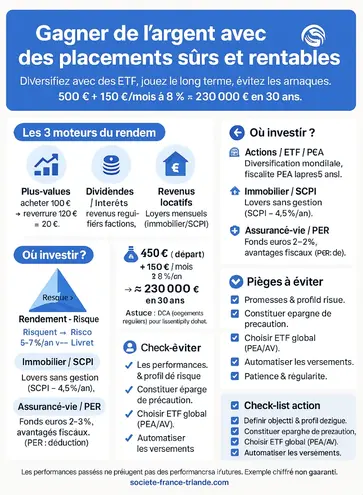
Here’s what you need to remember: Diversify with ETFs, focus on the long term and avoid scams. An initial investment of €500 €150/month at 8% p.a. could grow to €230,000 in 30 years. Patience and regularity are your best allies for a sustainable passive income.
Are your savings asleep without generating any income? Do you dream of making money by investing, but are lost for options? Discover the investments available (ETFs, SCPIs, life insurance) and the strategies tested by entrepreneurs like Camille, who multiplied her capital by 3 in 5 years through shares and SCPIs. This guide reveals the practical mechanisms (dividends, capital gains, rents) and simple steps for balancing return, risk and liquidity. Follow the story of Pierre, who generated €1,000 a month through an MSCI World ETF and regular payments. Turn your money into an ally today!
- Before you start: the basics of making money by investing
- Where should you invest your money? An overview of high-yield investments
- From €500 to €1,000 a month: your roadmap to passive income ️
- How to invest intelligently? Strategies for securing your gains ️
- The pitfalls you absolutely must avoid to protect your capital ❌
- Ready to get started? The summary for taking action!
Before you start: the basics of making money by investing
How does an investment actually generate money?
Investing means making your capital grow. There are three key mechanisms:
- Capital gains: Reselling an asset (share, property) at a higher price. Example: a share bought for €100 and sold for €120 generates a gain of €20. In 2023, Tesla shares rose by 50% in one year.
- Dividends or interest: Regular income without selling the asset. Dividends come from a company’s profits (such as Apple paying €1 per share in 2023), interest from loans (government bonds at 3% yield).
- Rental income: Monthly rent on a property. A flat rented for €1,000 a month offers a gross yield of 6% a year.
The essential trio: yield, risk and liquidity
Understand these three pillars:
Return: Expected gain in % (e.g. stock market ETF at 5-7% per annum). The higher the return, the greater the risk. A Livret A (3%) is secure but not very profitable.
Risk: Probability of losing capital. A company’s share price can fall by 50% quickly, unlike a government bond (minimal risk). This guide compares investments.
Liquidity: Speed of conversion into cash. A share can be sold in a few clicks, a property takes months. ETFs are more liquid than property, but less stable in the short term.
Defining your investor profile: the step not to be skipped
Adapt your strategy to your needs:
Objectives: Preparing for retirement (20-30 years) or buying a property in 5 years’ time requires opposite choices. A cautious profile chooses euro funds, while a dynamic profile opts for equities.
Risk tolerance: Can you withstand a 20% fall without panicking? A defensive portfolio (70% bonds) is suitable for the cautious, an offensive one (100% equities) for the daring.
Time horizon: Short-term (1-3 years) tends towards secure savings, long-term (10 years) absorbs stock market risks. Property is suitable for the long term because of its low liquidity.
Where should you invest your money? An overview of high-yield investments
The stock market: shares, ETFs and PEAs to boost your savings
Buying shares is like owning a stake in a company. Gains are possible through dividends and capital gains (resale). For example: an Apple share at €100 sold for €120 generates a gain.
ETFs (index funds) are accessible to small budgets. An MSCI World ETF exposes you to hundreds of global companies. Divided risk, simplified management.
The PEA (Plan d’Épargne en Actions) offers tax benefits: 75% of capital gains tax-free after 5 years. Perfect for beginners.
Property: from stone to paper (scpi)
Renting a physical property offers regular rental income, but requires a large budget (€100,000), unforeseen costs and active management.
With SCPIs, you can invest as little as €200 in commercial or residential properties. The management company manages everything: tenants, maintenance, rents.
In 2023, the average yield on SCPIs is 4.53%/year. An investment of €10,000 therefore yields €453 in annual income, without management.
Tax wrappers: life assurance and personal income tax
️ Life insurance combines euro funds (secure) and unit-linked funds (equities, REITs). After 8 years, withdrawals are taxed at 30%, compared with 45% for other products.
The PER reduces tax through deductions. A payment of €5,000 on an income of €40,000 saves up to €2,250. Returns on euro funds: 2-3%/year.
Find out about detailed plans for €10,000.
Comparative table of the main investments
| Type of investment | Potential return | Level of risk | Initial investment | Recommended investment horizon |
|---|---|---|---|---|
| Equities / ETFs | High (4-15%/year) | High | Low (from €50) | Long-term (5 years and more) |
| Rental property | Medium (2-5% net) | Medium | Very high | Very long term |
| SCPI | Medium (4-6%/year) | Medium | Low (from €200) | Long-term (8 years and more) |
| Euro funds (life insurance) | Low (2-3%/year) | Very low | Low (from €100) | Short / medium term |
| Bonds | Low to Medium | Low to Medium | Medium | Medium / Long term |
⚠️ To remember: Diversify your investments. A 100% equity portfolio is volatile but profitable over the long term, unlike bonds. Adapt your choice to your profile.
From €500 to €1,000 a month: your roadmap to passive income ️
Step 1: build up and invest your start-up capital
Start with an accessible budget, such as €500. The idea is not to wait until you’re rich, but to start now. MSCI World ETFs are perfect for a small budget: they track 1,325 global companies (technology, finance, industry) with annual fees (TERs) as low as 0.05% a year. For example: BNP Paribas or UBS ETFs, domiciled in Ireland, automatically reinvest dividends to simplify management. ETFs such as Xtrackers MSCI World (TER 0.12%) or Amundi Core (TER 0.12%) also offer greater liquidity thanks to their size (over €8 billion on average).
Step 2: the discipline of regular payments
Investing €150 a month on a regular basis? That’s the key. This method, known as DCA (Dollar Cost Averaging), eliminates the risks associated with the “emotional stock market”. By making monthly payments, you buy more shares when the markets fall and fewer when they rise. The result? A stable average purchase price and a crash-resistant portfolio. According to recent studies, 80% of regular investors avoid making impulsive decisions in this way. What’s more, this approach reduces the risk of bad timing: between 2000 and 2020, a one-off investor would have gained 95%, compared with 130% for a regular investor.
Step 3: the magic of compound interest in action ✨
Let’s imagine your savings: initial €500 €150/month at 8% annual return (non-guaranteed assumption). In 10 years, you get ~€30,000. In 20 years, ~€95,000. In 30 years, ~€230,000. But how can you live on this? The 4% rule says: withdraw 4% of the annual capital so as not to exhaust it. So €300,000 would give you €12,000 a year, or €1,000 a month. Warning: this rule, tested by William Bengen, assumes a diversified portfolio and low charges. In practice, lower rates (e.g. 5%) reduce annual withdrawals. For example, with €300,000 and a 5% return, you get €1,000 per month. Diversification is crucial: adding 20-30% in bonds (such as AGG ETFs) or property (REITs) stabilises income through regular flows (dividends, rents).
How to invest intelligently? Strategies for securing your gains ️
Diversification: the golden rule for limiting risk
Why risk everything by investing in just one type of asset? Diversification is the key to balancing your investments. As Boursorama points out, this strategy reduces unforeseen shocks.
- By asset class: Mix equities (Google, Tesla), bonds (government bonds) and property (SCPIs) to smooth returns.
- Geographic: Invest in Europe, Asia and the United States to avoid dependence on a single economy.
- Sectoral: Split between tech, health and energy (e.g. invest in a biotech and a renewable energy producer).
For those who want to explore original avenues, an alternative investment club offers atypical opportunities, such as financing eco-responsible projects.
The investment horizon: why time is your best ally
Time transforms volatility into opportunity. According to Boursorama, the risks of a stock market portfolio decrease drastically over the long term: 30% chance of loss in 1 year, but 0% over 50 years!
Investing in the stock market requires patience. An investment horizon of at least five years is recommended to smooth out market effects and maximise performance potential.
A concrete example: an investor who bought the S&P 500 index in 2008 went through some turbulence but saw his capital triple in 15 years. The key? Stay invested despite the crises.
The role of support: the advantage of an expert adviser
An independent wealth management adviser is a lever for investors looking for clarity. Unlike traditional banks, they avoid conflicts of interest by receiving no commission on products sold.
A good adviser will guide you in developing a personalised strategy. For example, a young entrepreneur might invest 70% in equities (Apple, Amazon) and 30% in property via REITs, while a retired person might prefer stable bonds (government bonds with a 5% yield). This is tailor-made management, with no commercial bias.
In short, diversification, patience and expert guidance make up a winning trio. These levers can be used to transform capital into an income-generating machine, whether in the form of dividends (like those of TotalEnergies), interest (bonds) or capital gains (SCPIs in full expansion).
Pitfalls to avoid if you want to protect your capital ❌
Beware of promises of rapid and unrealistic gains
If an offer seems too good to be true, it’s probably a scam! Promises of high returns without any risk are the main hook of financial scams. Vigilance is your best protection against the worst.
Promises of high returns without any risk are the main hook of financial scams. Vigilance is your best protection against falling for them.
The Autorité des marchés financiers (AMF) regularly warns of these practices. For example, bogus investments in crypto-assets lure investors in with grandiose promises, but often lead to outright losses. Here are some examples to be avoided at all costs:
- Forex or binary options trading.
- Fake crypto-currency platforms.
- Unregulated atypical investments (diamonds, wine, car parks, etc.).
Never invest in anything you don’t understand
The principle of Warren Buffett’s “circle of competence” is clear: invest in what you understand perfectly. For example, Buffett avoided tech stocks that were too complex, unlike his failure with Dexter shoes, which were affected by international competition.
To avoid mistakes, ask yourself these questions: – Can you explain a company’s business model simply? – Do you know its risks and valuation? – Have you studied its accounts and strategy?
Precautionary savings: your safety net first and foremost
️ Before investing, build up a safety cushion equivalent to 3 to 6 months’ expenses. This fund, placed in a risk-free medium such as the Livret A passbook savings account (rate at 2.40% in 2025), will prevent you from selling your investments in a hurry, often at a loss.
Here are the recommended investments for your precautionary savings:
- Livret A passbook savings account (ceiling: €22,950).
- Livret Goodvest (rate boosted to 4% for the first few months, limit: €5m).
- Livret d’Épargne Populaire (LEP) for people on modest incomes (rate at 3.50%, limit: €10,000).
Ready to get started? Here’s a summary to get you started!
Your 5-step action plan
- Take stock: Set your objectives (retirement, project) and your risk profile (e.g. tolerance adapted to your age).
- ️ Secure: Create precautionary savings (3-6 months’ outgoings) in Livret A passbook accounts or euro fund life insurance (2-4% return).
- Choose: Start with a global ETF such as the MSCI World via a PEA (7-10% return in 10 years).
- Automate: Monthly transfers (e.g. €100/month) for regular investment (smoothing effect and compound interest).
- ⏳ Be patient: An ETF at 8% will double in 9 years (rule of 72). SCPI after 5-10 years for passive income.
Final word
Starting with a little is already a step towards financial independence. Like Marie (€1,000/year in ETFs = 15k in 10 years) or Jean with SCPI rents. The key is not to wait for the perfect moment.
And if you’re looking for more inspiration, check out these 10 tried and tested ways to make money. The future is built today. Enjoy the ride!
Investing is a journey where every step counts. Define your profile, diversify. Patience and regularity turn small amounts into capital. Control the risks, avoid the mirages, keep a safety net. With a well-honed strategy, your money becomes leverage for the future. It’s up to you!
FAQ
What is the best investment for making money?
The ‘best’ depends on your profile, but ETFs (such as the S&P 500 index) and shares in large companies (e.g. Amazon) offer a good long-term risk/return balance. SCPIs, forproperty without management, are also popular. For example, a diversified MSCI World ETF allows you toinvest in 1,500 global companies from as little as €50.
Where can I invest €100 a month?
With €100 a month, opt for thematic ETFs (green energy, technology) or a PEA (Plan d’Épargne en Actions) for equities. Tip: automate payments into an S&P 500 ETF, as some investors do via platforms such as Degiro. This will build up a solid portfolio over 10-15 years thanks to compound interest.
How can €50 grow?
With €50, micro-investments are ideal: – Buying fractional shares (e.g. Apple at €1/share via Boursorama). – Crowdfunding platforms (loans between individuals, yield 4-6%). – Robo-advisors like Yomoni for automated management. Tip: some apps like Lydia or Qonto offer micro-savings.
How can you save €10,000 quickly? ⚠️
Trading crypto-currencies (e.g. Bitcoin, Ethereum) via Binance, but with a tolerance for total loss. – Freelancing or high value-added services (e.g. web development, marketing consultancy). – Asset sales (cars, gold) or property crowdfunding (e.g. Wiseed). Warning: err on the side of caution and only bet what you are prepared to lose.
How can I make €100 a day?
There are several methods: – Freelance (copywriting, design) via platforms like Malt. – Online sales of niche products (e.g. Etsy for handmade items). – Affiliation: promoting products via paid links (e.g. Amazon, Awin). Example: a content creator on TikTok can generate €100/day through partnerships.
How much should I invest to earn €1,000 a month?
Using the 4% rule, you need €300,000 in capital to generate €1,000/month in income. This can be achieved via : – A balanced portfolio (50% equities, 50% bonds). – SCPIs yielding 4-6% annually. For example: by investing €500/month at an 8% return, you would achieve this objective in 30 years thanks to compound interest.
Where should you invest your beginner’s money?
Beginners should look to: – Euro funds (life insurance) for security. – Indexed ETFs (e.g. Lyxor PEA S&P 500) for diversification. – PEA to benefit from tax exemption on capital gains. Tip: copy Warren Buffett’s portfolio (60% S&P 500, 40% bonds).
Is it possible tobuy €100 worth of Bitcoin?
Yes, €100 is enough to buy fractions of Bitcoin. Use platforms such as Binance or Coinhouse, which allow you toinvest as little as €10. For example: in 2020, €100 worth of Bitcoin was worth 0.01 BTC; in 2023, this represents ~€3,000 (beware of volatility).
How can you become a millionaire by saving $100 a month?
With an average annual return of 7%, $100 a month becomes $1m in 40 years. Method: – Invest via a securities account or a PER. – Favour low-cost ETFs (e.g. Vanguard Total Stock Market). – Example: a 25-year-old following this strategy would reach $1m by the age of 65, without excessive effort.