
🔑 Key Takeaways:
• Bookkeeping is the systematic process of recording, organising, and storing every financial transaction your business makes — it is the foundation of all sound financial management.
• Bookkeeping ≠ Accounting: bookkeeping captures raw data; accounting interprets it. Both are essential, but they serve different purposes.
• The double-entry system is the gold standard for growing businesses — every transaction affects two accounts, minimising errors and enabling professional financial reporting.
• Regular reconciliation (weekly or monthly) prevents fraud, catches mistakes early, and keeps your records audit-ready at all times.
• Modern tools like Finotor automate the most time-consuming bookkeeping tasks, giving business owners full financial visibility without the spreadsheet headache.
Whether you are launching a startup, running a small business, or managing a growing e-commerce operation, one question comes up sooner or later: what is bookkeeping, exactly, and why does it matter? The short answer is that bookkeeping is the backbone of every healthy business. Without it, you are essentially flying blind — unable to track profitability, prepare for tax season, or make informed decisions about growth.
In this guide, Finotor walks you through everything you need to know about bookkeeping in 2026 — from the basics of recording transactions to choosing the right system, staying compliant, and leveraging modern tools to save time.
1. The real bookkeeping definition for your business 📊
1.1. What exactly is bookkeeping in 2026?
At its core, bookkeeping is the process of recording, organising, and maintaining all financial transactions carried out by a business. Every time money moves in or out — a sale, a supplier invoice, a wage payment, a bank charge — that transaction needs to be captured accurately and stored in a retrievable format.
The person responsible for this work is called a bookkeeper. Their daily role involves:
- 📥 Recording transactions as they occur, using journals, ledgers, or accounting software
- 🗂️ Categorising each entry correctly (income, expense, asset, liability)
- 🔁 Reconciling accounts regularly to ensure internal records match bank statements
- 📂 Storing source documents — invoices, receipts, contracts — in an organised and retrievable way
- 📊 Preparing preliminary reports such as trial balances, which accountants then use for deeper analysis
In 2026, bookkeeping is no longer synonymous with rows of handwritten ledger entries. Cloud-based platforms, AI-assisted categorisation, and Open Banking integrations have transformed the discipline — but the underlying purpose remains unchanged: accurate records are the foundation of all sound business decisions.
“Good bookkeeping doesn’t just keep you compliant — it gives you a real-time picture of your business health that no gut feeling can replicate.”
Accurate books allow you to answer critical questions at any moment: Am I profitable this month? Can I afford to hire? Do I owe VAT this quarter? Without reliable bookkeeping, none of these questions can be answered with confidence.
1.2. Why bookkeeping and accounting aren’t the same
This is one of the most common points of confusion for business owners. Bookkeeping and accounting are related but fundamentally different disciplines, and understanding the distinction saves both time and money.
| Dimension | Bookkeeping | Accounting |
|---|---|---|
| Primary focus | Recording and organising past transactions | Analysing data and advising on future strategy |
| Nature of work | Administrative and operational | Analytical and advisory |
| Core tasks | Data entry, reconciliation, ledger maintenance | Financial statements, tax planning, auditing |
| Typical frequency | Daily / weekly | Monthly / quarterly / annually |
| Output | Organised ledgers, trial balances, source records | P&L statements, balance sheets, tax returns |
| Who does it | Bookkeeper, business owner, or software | Qualified accountant or CPA |
Think of it this way: bookkeepers gather the ingredients, accountants cook the meal. Without clean, accurate bookkeeping, even the most skilled accountant cannot produce reliable financial statements — and your tax returns, investment decisions, and loan applications will all suffer for it.
For small business owners, this means that good bookkeeping is not something you can delay until “tax season”. It is an ongoing operational habit, ideally supported by tools that remove the manual burden.
2. Choosing your system: Single vs Double entry 🛠️
Before you start recording transactions, you need to choose a bookkeeping method. In 2026, two core systems remain relevant: single-entry and double-entry. Your choice will depend on your business complexity, your growth ambitions, and your reporting requirements.
2.1. The simplicity of the single-entry method
The single-entry system is exactly what it sounds like: every financial transaction is recorded once, typically as either income or an expense, in a simple running log — similar to a personal chequebook.
How it works in practice:
- You received €500 from a client → record +€500 in income
- You paid €80 for office supplies → record -€80 in expenses
- At month-end, you tally the net to see your cash position
Who benefits most from single-entry:
- 🧑💻 Solo freelancers and consultants with straightforward cash flows
- 🌱 Micro-businesses in their first year of trading
- 📦 Side businesses with very few monthly transactions
The appeal is obvious: it is fast, requires no specialist knowledge, and can be maintained in a simple spreadsheet. However, single-entry has real limitations as your business grows:
- ⚠️ It provides no built-in error detection mechanism
- ⚠️ It cannot produce a proper balance sheet
- ⚠️ It gives a distorted picture when transactions involve credit, loans, or deferred payments
- ⚠️ Most lenders, investors, and auditors expect double-entry records
2.2. Why double-entry is the gold standard for growth
Double-entry bookkeeping is the system used by virtually every established business, accounting standard, and financial institution in the world. The principle, dating back to 15th-century Italy, is elegantly simple: every transaction affects at least two accounts — one is debited, and one is credited — and the totals must always balance.
If you want read more about double-entry bookkeeping, we have some details on Finotor.
A practical example:
- You pay a €1,200 annual software subscription by bank transfer
- → Debit Software Expenses account: +€1,200 (expense increases)
- → Credit Bank account: -€1,200 (asset decreases)
- → Net effect: zero. The books remain balanced.
Why double-entry is worth the extra discipline:
- ✅ Built-in error detection: if debits and credits don’t match, something is wrong — the trial balance immediately flags it
- ✅ Complete financial picture: every asset, liability, and equity movement is tracked simultaneously
- ✅ Professional reporting ready: your data can directly generate a Balance Sheet and an Income Statement
- ✅ Investor and lender confidence: double-entry records are universally understood and trusted
- ✅ Fraud detection: the self-balancing nature of the system makes it harder to conceal irregularities
“Double-entry bookkeeping is not just an accounting convention — it is a discipline that forces precision and reveals the true financial state of any business.”
Modern software like Finotor handles double-entry automatically behind the scenes, meaning you get all the rigour of the system without needing to manually calculate debits and credits for every transaction.
2.3. Cash vs Accrual: timing is everything
Beyond the entry system, you also need to choose when to record income and expenses. This is the cash basis vs accrual basis decision — and it has real implications for your tax liability and financial visibility.
| Criterion | Cash Basis | Accrual Basis |
|---|---|---|
| Income recorded when | Cash is received in the bank | Invoice is issued (regardless of payment) |
| Expense recorded when | Cash leaves the bank | Bill is received (regardless of payment date) |
| Simplicity | ✅ Simpler — mirrors your bank statement | ⚠️ More complex — requires tracking receivables/payables |
| Tax impact | Tax due only when cash received — better short-term cash flow | Tax may be owed on invoiced-but-unpaid income |
| Financial accuracy | Can distort profitability in periods of delayed payments | ✅ Reflects true economic activity of the period |
| Best suited for | Sole traders, micro-businesses, simple cash flows | Growing SMEs, businesses with credit terms, investors |
The 2026 direction: as your business grows, transitioning to accrual basis gives you a more accurate view of profitability and is typically required when working with external investors, applying for financing, or operating across multiple countries. If you start on cash basis, plan the transition before complexity overtakes your current system.
Finotor automates your transaction recording, bank reconciliation, and financial reporting — so you can focus on growing your business.
Start for free
Book a demo
3. Mastering the ledger and transaction records 📝
3.1. Navigating the Chart of Accounts
The Chart of Accounts (CoA) is the structured list of every financial category your business uses to record transactions. Think of it as the filing system for your entire financial history. Every entry you make in your bookkeeping system is assigned to a specific account within this chart.
The five core categories in any Chart of Accounts:
- 🏦 Assets — everything your business owns or is owed: cash, bank balances, accounts receivable, equipment, inventory
- 📋 Liabilities — everything your business owes: loans, unpaid supplier invoices, VAT payable, credit card balances
- 💼 Equity — the owner’s stake in the business: share capital, retained earnings, owner’s drawings
- 📈 Revenue — all income generated: sales, service fees, interest received
- 📉 Expenses — all costs incurred: salaries, rent, utilities, marketing, software subscriptions
All of these accounts feed into the General Ledger — the master record of every single transaction your business has ever made. The General Ledger is what your accountant uses to prepare your annual accounts and what a tax inspector would review in the event of an audit.
The Trial Balance is a periodic check drawn from the General Ledger. It lists all account balances and verifies that total debits equal total credits. A trial balance that doesn’t balance signals a bookkeeping error — catching it early prevents costly corrections further down the line.
👉 Learn how Finotor structures your accounts automatically: Finotor features overview
3.2. Reconciling bank statements and petty cash
Bank reconciliation is the process of comparing your internal bookkeeping records against your actual bank statement to ensure they match exactly. It is one of the most important — and most frequently neglected — tasks in small business bookkeeping.
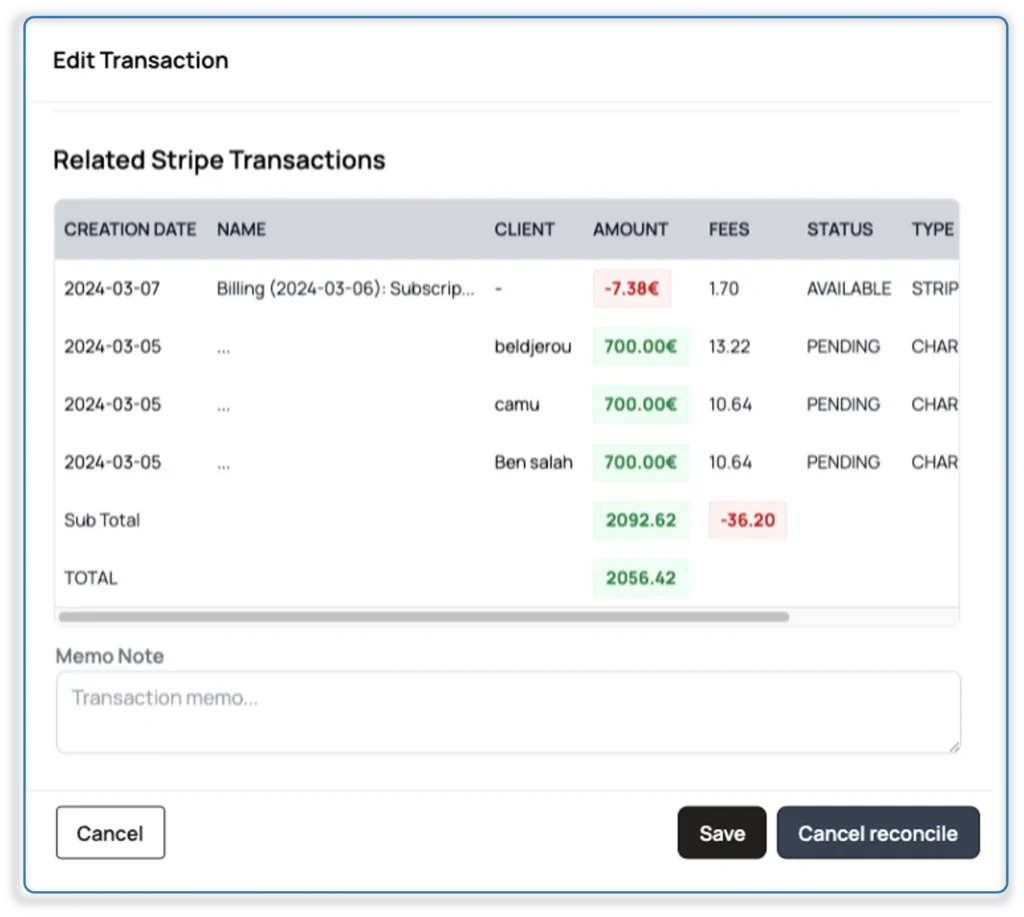
Stop manual reconciliation. Automate Stripe payouts with Finotor
The reconciliation process step by step:
- Obtain your bank statement for the period (monthly, or more frequently if volumes are high)
- Compare each bank transaction against your corresponding ledger entry
- Identify and investigate any discrepancies — timing differences, bank charges, missing entries
- Adjust your books accordingly and document any outstanding items
- Sign off the reconciliation and file it with your period-end records
Why it matters beyond simple accuracy:
- 🔍 Catches duplicate payments or missed invoices before they accumulate
- 🛡️ Detects unauthorised transactions or internal fraud early
- 📋 Provides a clean, verifiable audit trail for your accountant and tax authority
- 💰 Gives you an accurate picture of your real available cash — not just what your invoices say
Managing petty cash requires a similar discipline on a smaller scale. Keep a petty cash log recording every disbursement and its receipt. Reconcile the physical cash in the tin against the log at least weekly. Small leakages in petty cash are a common and easily preventable drain on small business finances.
For a complete step-by-step walkthrough of the reconciliation process, including how to handle NSF checks, outstanding items, and Stripe payouts, see our dedicated guide: How to reconcile bank statements.
Best practice in 2026: tools like Finotor’s AI-powered reconciliation engine automatically match bank transactions to recorded entries in real time, eliminating the manual matching process entirely and flagging discrepancies instantly.
3.3. Organising receipts and digital records
The era of the shoebox full of paper receipts is definitively over — and not just for convenience reasons. In most jurisdictions, digital record-keeping is now a compliance requirement, not merely a best practice.
2026 compliance standards for digital records:
- 📱 Receipts scanned or photographed must be legible, unaltered, and stored in a durable format (PDF or high-resolution image)
- ⏳ Most tax authorities require records to be retained for 6 to 7 years from the end of the relevant tax year
- ☁️ Cloud storage is now the standard — local hard drives are considered high-risk due to hardware failure
- 🔗 Under initiatives like Making Tax Digital (MTD) in the UK, digital links between your bookkeeping records and your VAT submissions are mandatory for VAT-registered businesses
Practical tips for organising digital records:
- 📂 Create a consistent folder structure by year and month in your cloud storage:
/2026/03-March/Sales-Invoices/ - 📸 Photograph receipts immediately on the day of the expense — don’t batch-process at month-end
- 🔤 Name files consistently:
2026-03-15_AWS_invoice_€89.pdfis infinitely more useful thanscan001.jpg - 🔄 Use a tool that automatically captures and categorises receipts — manual entry is the enemy of consistency
With Finotor, receipts can be scanned directly via the mobile app, automatically extracted using OCR, and matched to the corresponding transaction in your ledger — eliminating the manual filing step entirely.
4. Compliance, tax safety, and smart outsourcing 🚀
4.1. Staying audit-ready and meeting legal requirements
One of the primary reasons every business must maintain accurate books is simple: the law requires it. Regardless of your legal structure, size, or sector, you are legally obliged to keep financial records that accurately reflect your business activity.
Key legal requirements (applicable across most jurisdictions):
- 📅 Record retention periods: typically 6–7 years from the end of the accounting period in the EU, UK, and Ireland — longer for certain types of transactions
- 🧾 Source document requirements: every entry in your ledger must be supported by a corresponding document (invoice, receipt, bank statement, contract)
- 💻 Making Tax Digital (MTD, UK): VAT-registered businesses must maintain digital records and submit returns through MTD-compatible software — paper records alone are no longer compliant
- 🏛️ Annual accounts filing: limited companies must file accounts with the relevant company registry (e.g., Companies House in the UK, CRO in Ireland) — inaccurate bookkeeping makes this impossible
What “audit-ready” means in practice: you should be able to produce, at any time, a complete transaction history for any requested period, with each entry linked to a source document. If your books are up to date, a tax audit becomes an administrative exercise. If they are not, it becomes an expensive crisis.
“The cost of an audit when your books are clean is a few hours of your accountant’s time. The cost of an audit when your books are in disarray is measured in weeks, legal fees, and potential penalties.”
Clean bookkeeping reduces your tax risk in a second way: when your records are accurate and complete, you can legitimately claim every allowable deduction — travel, equipment, software, professional fees. Disorganised records mean you either miss deductions or, worse, claim ones you cannot substantiate.
4.2. DIY vs outsourcing: making the right choice
For many entrepreneurs, the honest question is: should I handle my own bookkeeping, or pay someone to do it for me? There is no universal answer — but there is a structured way to think about it.
| Factor | DIY Bookkeeping | Professional Bookkeeper |
|---|---|---|
| Monthly cost | Low (software only: €0–€50/mo) | €150–€600+/mo depending on volume |
| Time investment | 3–10 hrs/month (on your time) | Minimal — time is outsourced |
| Error risk | Higher without accounting background | Lower — professional accountability |
| Financial visibility | ✅ High — you know your numbers intimately | Depends on reporting frequency agreed |
| Scalability | Limited — breaks down with volume growth | ✅ Scales with your business needs |
| Best for | Freelancers, micro-businesses, early-stage startups | SMEs with complex transactions, multiple entities |
The 2026 recommendation: a hybrid approach. Modern bookkeeping platforms have made the DIY option significantly more viable than it was a decade ago. A business owner using smart software can handle day-to-day recording and reconciliation themselves — with a professional accountant reviewing the books quarterly and filing the annual accounts. This preserves visibility, reduces cost, and ensures compliance.
Three signals that it’s time to outsource your bookkeeping:
- 🔴 You are spending more than 5 hours per week on bookkeeping tasks
- 🔴 You have more than 2–3 months of unreconciled transactions
- 🔴 You are unsure whether your records comply with current legal requirements
If your books are up to date, you can correct ledger entry mistakes relatively easily — by posting a correcting journal entry with a clear explanation. The key is catching errors quickly, which is why frequent reconciliation (not annual catch-up) is the correct operating model.
4.3. Using Finotor for seamless financial management
Finotor is an all-in-one AI-based accounting and bookkeeping platform designed for entrepreneurs, startups, and small businesses who want financial clarity without the administrative burden.
What Finotor does for your bookkeeping in 2026:
- 🔗 Bank synchronisation: connect your business bank accounts and payment platforms — transactions are automatically imported in real time, eliminating manual data entry
- 🤖 AI-powered categorisation: Finotor’s machine learning engine learns your transaction patterns and categorises entries automatically — with a human review layer when needed
- 🧾 Receipt capture: photograph receipts via mobile, extract data via OCR, and match them to transactions automatically — no more shoebox
- 💳 Stripe reconciliation: for e-commerce and SaaS businesses, Finotor natively reconciles Stripe payouts against your ledger, handling the T+2 settlement timing that trips up most bookkeeping tools
- 📊 Real-time dashboards: live cash flow tracking, revenue vs expense overview, and financial health indicators — always available, always current
- 🏦 Open Banking integration: connect multiple banks and financial platforms in a unified view, including multi-currency accounts
- 📤 Accountant-ready exports: share clean, structured data with your accountant at any time — no reformatting, no email attachments of spreadsheets
“Finotor bridges the gap between simple transaction tracking and expert-level financial analysis — giving you the visibility of a CFO without the salary.”
For business owners who want to stay in control of their finances without becoming full-time bookkeepers, Finotor is the practical answer to the “DIY vs outsource” dilemma. The platform handles the mechanical work; you retain full visibility and make better decisions as a result.
👉 Finotor for entrepreneurs — see how it fits your business model
👉 Finotor for accountants and bookkeepers — if you work with a professional firm
👉 Plans & pricing — start free, upgrade as you grow
📋 Practical bookkeeping checklist: daily, weekly, and monthly tasks
Consistent bookkeeping is built on small, regular habits — not frantic end-of-year catch-up sessions. Here is a practical task framework you can implement immediately:
| Frequency | Task | Why it matters |
|---|---|---|
| Daily | Record all sales and income received | Prevents gaps in revenue tracking |
| Photograph and file all receipts and expenses | Receipts fade — capture them immediately | |
| Review pending invoices and payments due | Maintains healthy cash flow | |
| Weekly | Reconcile bank transactions against ledger | Catches errors and fraud early |
| Send outstanding sales invoices and follow up on overdue payments | Protects cash flow and reduces late payments | |
| Review petty cash log and replenish if needed | Prevents unrecorded cash leakage | |
| Monthly | Complete full bank reconciliation for all accounts | Required for period-end accuracy |
| Review P&L and cash flow statement | Informs business decisions for the month ahead | |
| Prepare and submit VAT return (if applicable) | Avoids penalties and interest on late submissions | |
| Back up all financial records to cloud storage | Protects against data loss and compliance failure |
FAQ — Bookkeeping questions answered
Is bookkeeping difficult for someone without an accounting background?
Not necessarily. Basic bookkeeping — recording income and expenses, matching bank transactions, filing receipts — can be learned quickly with the right tools. The double-entry system has a learning curve, but modern software like Finotor handles the mechanics automatically, leaving you to focus on reviewing and understanding your numbers rather than manually processing entries. The key is consistency, not expertise.
What are the legal requirements for keeping business records?
In most EU countries, the UK, and Ireland, businesses are required to retain financial records for 6 to 7 years from the end of the relevant accounting period. Records must include source documents (invoices, receipts, contracts) and must be organised in a way that allows reconstruction of all transactions. In the UK, VAT-registered businesses must comply with Making Tax Digital (MTD) requirements, which mandate digital record-keeping and software-based submissions.
Should I handle my own bookkeeping or outsource it to a professional?
It depends on your transaction volume, available time, and complexity. For freelancers and micro-businesses with straightforward finances, DIY bookkeeping using modern software is entirely viable. For businesses with significant transaction volumes, employees, VAT obligations, or multi-currency activity, professional support becomes cost-effective quickly. A hybrid model — software for daily recording, professional review quarterly — works well for most growing SMEs.
How often should I update my financial records?
Ideally, daily for high-volume businesses, and at minimum weekly for everyone else. Waiting until month-end creates a significant administrative backlog and means financial decisions in the intervening weeks are based on incomplete data. The shorter the gap between a transaction and its recording, the more accurate and useful your books will be.
What happens if I make a mistake in my ledger entries?
In a double-entry system, errors are caught during the trial balance — the totals simply won’t balance. The correction is made via a correcting journal entry, with a clear description of what was wrong and what has been corrected. You should never delete or alter an existing entry — always post a new entry that reverses the error. Good bookkeeping software maintains a full audit trail of all entries and amendments.
What is the difference between a daybook and a general ledger?
A daybook (or book of prime entry) is where transactions are first recorded in chronological order — it is the initial capture point for sales, purchases, receipts, and payments. The General Ledger is the organised master record where all those daybook entries are posted by account category. The daybook answers “what happened today?” — the General Ledger answers “what is the total balance of each account?”
To learn more about bookkeeping :
– Is bookkeeping hard for beginners? Master the basics easily
– Will AI replace bookkeepers? The future of financial advice
– Bookkeeping vs accounting: What’s the difference in 2026
– How to reconcile bank statements? Complete Guide for Beginners
– Understanding Double-Entry bookkeeping for your business
– How to do bookkeeping for a small business?
Finotor automates your financial records, reconciles your accounts, and gives you real-time visibility — all in one platform.
Start for free
Book a demo