
The key takeaway: 💡 Crypto offers diverse income streams—from high-risk trading to passive staking (Ethereum yields ~1.9%, Cosmos 15.21% APY). However, 2023 saw $5.6B lost to fraud, underscoring the need for caution. Finotor streamlines crypto finance management, helping track gains and minimize risks. DYOR and start small to navigate this volatile market wisely.
Feeling lost about how to make money with cryptocurrency? 🤯 Between wild price swings and endless strategies, it’s easy to feel overwhelmed. 💸 This article breaks down proven ways to profit—from active trading to passive income streams like staking (Ethereum’s 1.90% APY, anyone? 💡). We’ll also show you how tools like Finotor simplify tracking gains and managing crypto finances, so you focus on growing your digital wallet. 📈 Whether you’re a side-hustler or full-time investor, discover strategies that turn crypto chaos into opportunities. 🚀 From staking rewards to lending your USDC, Finotor ensures every transaction is tracked, so you stay on top of taxes and cash flow. 📊
- So You Want To Make Money With Crypto? Let’s Start With The Basics
- Active strategies: for those who like to be hands-on 📈
- Passive Income With Crypto: Make Your Money Work For You 🏖️
- More ways to earn crypto: think outside the box 💡
- Managing your crypto journey: risks, taxes, and tools 🛠️
- So, what’s next for you? your crypto action plan 🚀
So You Want To Make Money With Crypto? Let’s Start With The Basics
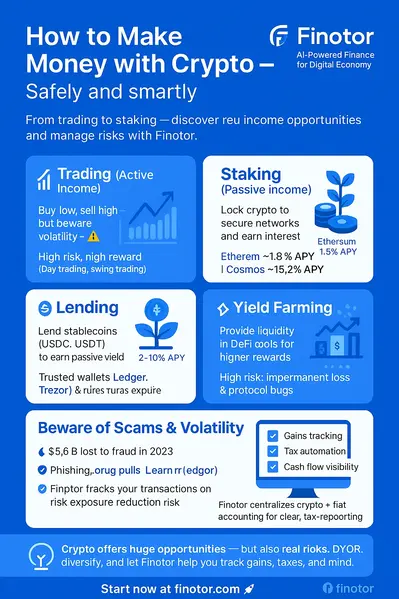
How to make money with cryptocurrency
Have you ever wondered how people earn with crypto? 🤔 It’s not luck—it’s strategy. Whether staking, hunting airdrops, or playing play-to-earn games, opportunities exist… but risks too. Let’s cut through the noise. Crypto isn’t sci-fi; it’s reshaping finance. First, what even is cryptocurrency, and why should you care? Think of it as digital money that’s changing how we trade value globally. 💡
What Is Cryptocurrency, Really? 🤔
Imagine money that exists purely online, free from bank or government control. That’s crypto—fully decentralized. 🚀 It runs on blockchain tech: a tamper-proof digital ledger verified by a global network of computers. Bitcoin (BTC), born in 2009, proved this concept. Ethereum (ETH) evolved it with smart contracts—self-executing deals powering apps. Your crypto lives in a wallet you control, no middlemen needed. But remember: “With great power comes great responsibility” 💼.

Video: How to make money with cryptocurrency
The Big Question: Is It Really Possible To Make Money? 💰
Yes… but not easily. 🤓 The market peaked at $3.7T, but crypto isn’t a magic ticket. It’s a rollercoaster: Bitcoin dropped 70% before. That’s why crypto fans live by DYOR (Do Your Own Research). Would you invest blindfolded? Nope. Research matters—study projects, check tokenomics, or use tools like Finotor for financial tracking. Here’s the deal:
- Rewards = high risks
- Volatility = fast gains/losses
- Success needs strategy, not luck
- Knowledge is your edge
Treat crypto like a startup—it takes research, patience, and planning. Ready to explore earning methods like staking or airdrops? Let’s dive deeper! 🔍
Active strategies: for those who like to be hands-on 📈
The world of crypto trading
Craving action? Crypto trading might be your jam! 🚀 It’s all about buy low, sell high on exchanges like Binance or Coinbase. Think of it as a 24/7 game where you bet on price swings. Day traders swing-trade within hours, while swing traders hold for days. Both need sharp skills: technical analysis (reading candlestick charts), risk management (setting stop-losses), and staying glued to news. Example: Brian Armstrong, Coinbase’s CEO, built his fortune by understanding market trends. But remember, it’s not a side hustle—it’s full-time work! 💼
A word on CFDs and leverage: the high-risk, high-reward game
Want to bet on crypto prices without owning the coins? Enter CFDs (Contracts for Difference)! 📉 Here’s the catch: you can go “long” (bet on rising prices) or “short” (predict a drop). Add leverage—borrowing funds to magnify gains—and you’re in a high-stakes arena. 🎰 Example: A 10x leveraged bet on Bitcoin could multiply gains or losses tenfold. Platforms like eToro offer these tools, but warnings flash red: “76% of retail investors lose money trading CFDs.” ⚠️ Risk? Huge. Reward? Potentially huge. Not for the faint-hearted.
Buy and hold (or “HODL”): the long-term game
Patience pays! HODLing means buying and holding crypto for years. Take Laszlo Hanyecz, who traded 10,000 BTC for two pizzas in 2010 🍕—those BTC would’ve been worth $1.1B by 2025! This strategy suits believers in projects like Ethereum or Solana. No need to stress over daily swings; just ride the wave. Pro tip: Use tools like Finotor to track portfolio growth. But hey, conviction matters—will you panic when prices dip 30%? 🧠
What drives the prices?
Crypto prices are wild, right? Let’s break down the why:
- Supply and Demand: Like gold, scarcity matters. Bitcoin’s capped at 21M coins—lose some, and scarcity spikes! 🔥 Example: Lost wallets reduce supply, pushing prices up when demand stays steady.
- Market Capitalization: A $1T market cap for BTC means investors trust it more than altcoins with $50M caps. Higher market cap signals investor confidence compared to smaller altcoins.
- Media Hype: A tweet from Elon Musk can send Doge to the moon 🚀, while a crypto hack can crash prices.
- Integration: When PayPal adds crypto payments, adoption—and price—soar. 📈
- Key Events: China’s 2021 mining ban crushed prices, while ETF approvals can spark rallies. 📊
Stay alert to these triggers—they’re your roadmap in this rollercoaster! 🎢
Passive Income With Crypto: Make Your Money Work For You 🏖️
Staking: Earn Rewards For Supporting The Network
Staking turns your crypto into a digital seed 🌱 that grows while securing blockchains. Lock Ethereum (1.90% APY), Solana (4.30% APY), or Cosmos (15.21% APY) to validate transactions—no need to sell. Platforms like Binance and Kraken let you start with as little as $10, but slashing penalties apply if networks detect downtime ⚠️. Your coins stay under your control, but rewards depend on network participation rates.
Example: Staking 100 ETH (~$200k) at 1.90% APY earns $3,800 yearly. But crypto prices swing wildly—stablecoins like USDT (600% APY on Bitcompare.net) carry hidden risks 🔥. For long-term holders, staking beats idle wallets. Pro tip: Use Coinbase’s new USDC lending (10.8% APY via Morpho) to diversify income streams.
Crypto Lending: Become The Bank
Turn USDC into a profit machine 🏦 by lending via platforms like Finotor’s peer-to-peer system (2-10% APY). No technical setup needed—deposit and earn. But 2022’s Celsius collapse shows platform risks: always verify security features like multi-sig wallets and insurance. Beginners should stick to stablecoins like USDC to dodge volatility. Advanced users might explore DOGE (344% APY on Bitcompare.net), but that’s for thrill-seekers only. Coinbase’s lending feature even rewards holders with 4.1% APY—no active trading required.
Yield Farming And Liquidity Pools: The Next Level Of Passive Income
Yield farming is DeFi’s high-stakes game 🤠. Provide ETH/DAI liquidity on Uniswap to earn fees + governance tokens (e.g., CRV). But impermanent loss bites when prices shift. Deposit 1 ETH + $2,000 USDT. If ETH hits $8,000, arbitrage leaves you with 0.5 ETH + $4,000—a $2,000 loss vs. holding. Wired calls this “DeFi’s silent profit killer.”
Play smart with these tactics:
- Use stablecoin pairs (USDT/USDC) to slash impermanent loss 💰
- Farm governance tokens (e.g., UNI) for extra gains 🎁
- Choose audited platforms like Curve Finance for stable pools 🛡️
Rug pulls like 2021’s $60M AnubisDAO exit scam prove due diligence matters. Check open-source code and real teams. As Britannica warns: “Only risk what you can afford to lose.”
| Method | How It Works | Potential Return (APY) | Key Risk(s) | Best For… |
|---|---|---|---|---|
| Staking | Lock crypto to support a network | Low to Medium (1–15%) | Slashing / Volatility | Long-term holders |
| Lending | Lend via platforms | Low to Medium (2–10%) | Platform risk / Default | Beginners |
| Yield Farming | Provide DEX liquidity | Very High (>100%) | Impermanent Loss / Bugs | Advanced users |
Blend methods for balance: stake 50% ETH for safety, lend 30% USDC on Finotor, and farm 20% in Curve’s stable pools. Rebalance quarterly to catch fresh opportunities. DeFi moves fast—yesterday’s 10% APY could vanish. Stay sharp 🌟.
Remember: Diversify across platforms and assets. Use tools like DeFi Pulse to track top protocols. For beginners, Finotor’s lending platform offers a low-risk entry point. Advanced users might explore Nexus Mutual for smart contract insurance. The key? Stay informed and never invest more than you can afford to lose.
More ways to earn crypto: think outside the box 💡
Airdrops: free tokens in your wallet?
Airdrops distribute free tokens to build communities or reward early adopters 🛡️. Projects like Uniswap rewarded 250,000 addresses with 400 UNI tokens in 2020 for prior platform use. To qualify, you might need to hold specific tokens (e.g., ETH) or interact with dApps before a blockchain snapshot. Always verify eligibility through official channels—scammers often mimic these opportunities with fake sites or phishing emails.
Scammers create fake airdrops to steal private keys or trick users into malicious transactions. Never share your recovery phrase—legit projects will never ask for it. If tokens drop unexpectedly in your wallet, cross-check their contract address on Etherscan. Use Finotor to track airdrop earnings and manage crypto securely while avoiding scams 🛡️.
Play-to-earn (P2E) games: get paid to play
Games like Axie Infinity let players earn tokens like SLP by completing quests or trading NFTs 🎮. Most require upfront NFT investments (e.g., Axie creatures) that can lose value during crashes. Risks include token volatility and “rug pulls” (projects disappearing). Volatility is brutal—SLP’s value dropped 90% in 2022. Research teams and roadmaps thoroughly. Start small: earn free starter assets to test games. Tools like Finotor help track P2E earnings and manage portfolios. Join Discord communities to spot red flags early!
What about crypto mining?
Mining sounds simple: validate transactions, earn crypto. Bitcoin’s Proof-of-Work network turned it into an industrial arms race ⚙️. You’ll need ASIC miners costing $2k+ and cheap electricity (<$0.05/kWh). Even then, network difficulty and halving events make solo mining unprofitable. Joining pools shares rewards but cuts returns with 1–2.5% fees. Cloud mining and hosting rigs often hide scams. For most, staking Ethereum or Solana offers better ROI. Track expenses and ROI with Finotor to avoid losses 💸.
“While there are many ways to earn, remember that the crypto space is filled with opportunities and risks. Always do your own research before investing time or money.”
Managing your crypto journey: risks, taxes, and tools 🛠️
The inevitable risks of crypto
Even pros face crypto risks. In 2023, fraud cost users $5.6 billion – 71% from scams. Over-60 investors lost over $1.6 billion – age doesn’t protect you. 🚨 Phishing attacks, fake apps, and “rug pulls” (scams where developers abandon projects) add to the chaos.
Stay safe:
- Use trusted exchanges (Coinbase, Binance) with proven security audits and insurance funds.
- Store big holdings in hardware wallets (e.g., Ledger, Trezor) – offline vaults that avoid breaches like Axie Infinity’s $625M hack.
- Use app-based 2FA (Google Authenticator > SMS, which risks SIM-swapping).
- Always do your own research (DYOR) – avoid “free crypto” airdrop scams or phishing links.
Taxes are coming for crypto
The IRS treats crypto as property – every sale, swap, or purchase is taxable. Examples:
- Selling ETH for USD? Pay capital gains (short-term: up to 37%, long-term: max 20%).
- Buying a laptop with BTC? Calculate your cost basis (original value) first.
- Staking rewards? Taxed as income at your regular rate (up to 37%).
Track dates, values, and purposes. Finotor automates this, including capital losses to offset gains (up to $3,000/year). For instance, if you sold ETH at a loss, use it to reduce taxable income from your freelance crypto work.
Finotor: Your crypto finance solution
Tracking crypto with regular income is messy. Finotor simplifies it. Imagine generating tax-ready reports for Shopify sales and crypto earnings – no spreadsheets! 🚀
Use real-time cash flow tracking and multi-currency support to manage crypto + traditional income. A freelance developer earning ETH from global clients can auto-categorize transactions and reconcile with USD bank accounts. Sync crypto with Shopify sales or Stripe payments using AI-powered reconciliation.
“Managing crypto finances is as important as making them. Clear data fuels growth and peace of mind.”
With Finotor for entrepreneurs, scenarios like staking (taxed as income) or airdrops become organized. No guesswork – just accountant-ready data. For example, an e-commerce store accepting BTC payments can auto-track sales, fees, and expenses in one dashboard. 📊
So, what’s next for you? your crypto action plan 🚀
Making money with crypto isn’t magic—it’s strategy. Whether you’re into staking, airdrops, or play-to-earn games, the key is to start small and stay curious 🧐. Remember: volatility is normal. Your goal? Keep learning, stay proactive, and never risk more than you’re ready to lose.
Got $100 or $1,000? Platforms like Finotor can help you track your investments and manage your crypto finances seamlessly. Check out Finotor’s tools to simplify your journey 🛠️.
Your crypto adventure starts now. Will you stake your first ETH, try a play-to-earn game, or explore airdrops? Share your plan below ⬇️. Good luck—you’ve got this! 🚀
Your crypto journey starts with DYOR 💡 — explore trading, staking, or passive income like lending. Stay alert: crypto’s wild 🌊, but tools like Finotor simplify tracking gains & taxes. Start small, stay curious, and remember: risks = rewards. Ready to dive in? 🚀 [Explore Finotor](https://finotor.com/how-make-money-online/) for seamless crypto finance management!
FAQ
Can you really earn money through crypto? 💰
Yes, but it’s not a magic money printer! 🚨 Thousands have made gains via trading, staking, or building crypto-based businesses. For example, early Bitcoin adopters who HODL’d saw massive returns. However, crypto moves fast — prices swing wildly, and risks are real. The key? Start small, learn constantly, and track your moves with tools like Finotor to stay on top of taxes and cash flow. It’s a game for the patient, not the greedy! 📊
Is making $100 daily with crypto realistic? 💸
Possible… but not guaranteed. 🤷♂️ Day traders like Johnathan Hobbs, who turned $500 into $30K in 6 months, exist — but they’re the exception, not the rule. Crypto’s volatility means you could gain or lose $100 in minutes. Pro tip: Use Finotor to manage your side-hustle earnings and avoid tax headaches. If you’re new, pair this with stable income, not rely on it full-time. Small steps, big results! 🚀
What happens if I invest $1,000 in Bitcoin today? 📈
It depends on market vibes. 📊 If history repeats (like Bitcoin’s 300% surge in 2021), $1K could become $4K. But crypto’s a rollercoaster — it could dip too! Compare it to 2017, where $1K turned into $13K, then dropped 70% in 2018. Track your investment with Finotor to monitor gains/losses in real-time and stay tax-compliant. Pro tip: Pair with a diversified portfolio! 💼
How much crypto can $100 buy? 💵
It’s like asking how many pizzas $100 buys — depends on the crypto’s price! 🍕 At $30K/BTC, $100 gets 0.0033 BTC. With cheaper coins like XRP ($0.45), you’d snag 222 tokens. Platforms like Finotor let you invest small amounts and track micro-gains — perfect for testing the waters without diving in headfirst. Start small, learn the ropes, and scale up! 📈
What if I invested $1K in Bitcoin 5 years ago? 📊
You’d be grinning today! 🎉 In 2018, $1K bought ~1 BTC. By 2021, that hit $60K. Even with dips, long-term HODLers win. But past =/= future — crypto’s wild. Use Finotor to track historical gains and plan your next move. Knowledge is power! 🔍
How much is $500 worth in Bitcoin? 💸
Simple math: $500 equals $500 in Bitcoin value. The catch? BTC’s price changes hourly. If it’s $30K/BTC, you’d have ~0.0167 BTC. Use Finotor to convert live prices and manage your holdings — especially handy if you’re juggling crypto with other income streams. Crypto’s flexible, not free — stay informed! 📲
Is investing $20 in Bitcoin smart? 🧠
Totally! 🚀 Micro-investing (like $20/month) builds wealth over time. Apps let you buy fractions of BTC, ETH, or altcoins. Remember: $20 won’t make you rich, but it’s a low-risk way to learn. Track these tiny bets with Finotor — automate your crypto finances and watch your portfolio grow. Small bets, big dreams! 💎
What’s the 3-5-7 rule in day trading? 📐
It’s a risk management hack! 🛠️ Traders use 3% (max loss/day), 5% (weekly), 7% (monthly) to avoid blowing up their account. Think of it like seatbelts — safety first! Pair this with Finotor’s expense tracking to monitor trading costs and tax deductions. Discipline > luck in the long run. 🎯
How much is $200 worth in Bitcoin? 💵
Same as its dollar value — $200. But BTC’s price determines how much you get. At $30K/BTC, you’d have ~0.0067 BTC. Use Finotor to convert live rates and manage small investments — especially if crypto’s a side hustle. Every drop adds up! 💧