
Church Accounting Software: Features, Reports & Best Practices
Churches and religious organizations face unique financial management challenges that standard accounting methods often fail to address effectively. From tracking donations across multiple funds to generating specialized financial reports for board meetings and audits, church accounting requires dedicated solutions that understand the complexities of nonprofit financial management.
 What makes church accounting different
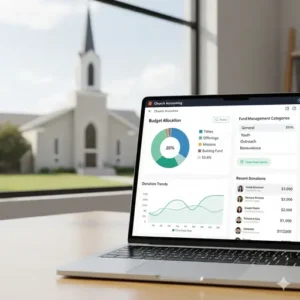
Managing church finances involves distinct requirements that set it apart from traditional business accounting. Churches must track donations by fund, manage restricted and unrestricted contributions, and maintain detailed records for both internal oversight and regulatory compliance. Traditional spreadsheets and basic bookkeeping methods often create more complications than solutions, leading to time-consuming manual processes and increased risk of errors.
Religious organizations need accounting systems capable of handling multi-fund accounting, where different revenue streams and expenses are categorized according to their designated purposes. Whether managing building funds, mission contributions, or general operating expenses, churches require clear financial separation and comprehensive reporting capabilities.
Essential features for church financial management
Donation tracking and management
Modern church accounting software should provide comprehensive donation tracking that automatically categorizes contributions and generates accurate donor statements. This functionality eliminates hours of manual data entry while ensuring precise records for both donors and church administration.
Key donation management capabilities include:
- Automatic contribution categorization
- Donor statement generation
- Pledge tracking and monitoring
- Tax receipt preparation
- Campaign and event fundraising reports
Automated expense management
Automated expense management streamlines the process of recording and categorizing church expenditures. From utility payments to ministry expenses, automated systems can connect directly to bank accounts and credit cards, reducing manual input while maintaining detailed records for budgeting and reporting purposes.
| Expense Category | Automation Benefits | Time Savings |
|---|---|---|
| Utilities | Auto-categorization | 75% reduction |
| Ministry supplies | Receipt scanning | 60% reduction |
| Staff expenses | Direct imports | 80% reduction |
Fund accounting capabilities
Fund accounting capabilities allow churches to maintain separate financial records for different programs and purposes while providing consolidated reporting when needed. This ensures that restricted donations are properly allocated and that financial oversight meets both internal governance requirements and external regulatory standards.
Streamlined financial reporting
Specialized church reports
Churches require specialized financial reports that differ significantly from standard business statements. Automated financial reporting generates statements of activities, statements of financial position, and detailed fund reports that board members and stakeholders need for informed decision-making.
Essential reporting features include:
- Statement of activities generation
- Balance sheet preparation
- Cash flow analysis
- Budget variance reports
- Denominational reporting compliance
Real-time financial insights
Real-time financial insights provide church leadership with current information about cash flow, budget performance, and donation trends. This immediate access to financial data enables proactive management and strategic planning rather than reactive responses to financial challenges.
Audit-ready documentation
Audit-ready documentation ensures that all financial transactions are properly recorded and easily accessible for internal reviews or external audits. Automated systems maintain detailed transaction histories and supporting documentation that manual processes often struggle to organize effectively.
Integration and automation benefits
Banking integration
Banking integration eliminates the need for manual transaction entry by automatically importing bank statements and matching transactions to appropriate accounts and funds. This reduces processing time while improving accuracy and reducing the likelihood of posting errors.
AI-powered automation
AI-powered automation can categorize recurring transactions, suggest appropriate fund allocations based on historical patterns, and flag unusual transactions for review. These intelligent features reduce administrative burden while maintaining the oversight necessary for responsible financial stewardship.
Automation capabilities include:
- Transaction categorization
- Recurring payment setup
- Duplicate detection
- Anomaly identification
- Report scheduling
Seamless integration
Seamless integration with donation platforms and church management systems creates a unified ecosystem where financial data flows automatically between different tools, eliminating duplicate data entry and ensuring consistency across all systems.
Moving beyond manual processes
Traditional methods like spreadsheets and paper-based systems create numerous pain points for church financial management. Manual processes are time-intensive, prone to errors, and make it difficult to generate timely reports or maintain proper internal controls. These limitations often result in financial information that becomes outdated by the time it reaches decision-makers.
Modern cloud-based solutions provide secure access to financial data from anywhere, enabling treasurers and financial committees to stay current with church finances without being tied to a specific computer or location. This accessibility proves particularly valuable for volunteer treasurers who may need to work on church finances outside of regular office hours.
Choosing the right solution for your church
Church size considerations
Small churches often benefit from solutions that provide essential accounting features without overwhelming complexity, while larger organizations may need more sophisticated fund management and reporting capabilities. The key involves finding a platform that can scale with your organization as it grows and evolves.
| Church Size | Primary Needs | Recommended Features |
|---|---|---|
| Small (under 100) | Basic fund tracking | Simple reporting, donation management |
| Medium (100–500) | Multi-fund management | Advanced reporting, integration options |
| Large (500+) | Complex operations | Full automation, custom reporting |
Support and resources
Look for solutions that offer dedicated customer support and resources specifically designed for religious organizations. Churches have unique questions and challenges that require knowledgeable assistance from teams who understand nonprofit accounting principles and church-specific requirements.
Consider platforms that provide training resources and implementation support to help your team transition from existing systems. The most powerful software proves effective only when your team understands how to use it properly and efficiently.
Making the transition
Implementing new accounting software doesn’t have to be overwhelming. Modern platforms like Finotor are designed to simplify the transition process with guided setup procedures and data import tools that can migrate information from existing systems. This approach minimizes disruption to ongoing operations while ensuring that historical financial data remains accessible.
Conclusion
The right accounting solution transforms church financial management from a time-consuming administrative burden into an efficient, transparent process that supports better stewardship and decision-making. By automating routine tasks and providing clear financial insights, churches can focus more energy on their mission and less on manual bookkeeping processes.
Ready to explore how modern accounting technology can streamline your church’s financial management? Finotor offers comprehensive solutions designed specifically for organizations that need sophisticated fund accounting capabilities combined with user-friendly interfaces and reliable automation features.