
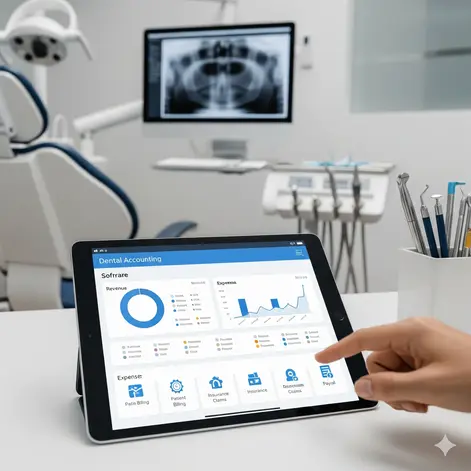
Managing the financial aspects of a dental practice requires specialized tools that go beyond basic bookkeeping. Traditional methods like spreadsheets and manual processes often fall short when handling the unique complexities of dental practice finances, from patient billing cycles to insurance reimbursements and equipment depreciation. So it’s not hard to see why Dental Accounting Software is a must-have.
Essential features for dental practice financial management
Modern dental accounting software combines multiple financial functions into a unified platform, streamlining operations that previously required separate tools and manual coordination.
Automated invoicing capabilities
Automated invoicing eliminates the time-consuming process of creating patient bills manually. The system generates professional invoices automatically based on treatment codes and insurance information, reducing errors and accelerating payment cycles. Recurring billing handles ongoing treatments and payment plans seamlessly.
Comprehensive expense tracking
Comprehensive expense tracking captures all practice-related costs, from supply purchases to equipment financing. Mobile receipt scanning and automatic categorization ensure no deductible expense goes unrecorded, while integration with a dental-specific chart of accounts provides accurate categorization.
Key expense categories for dental practices:
- Supply costs and inventory management
- Equipment purchases and depreciation
- Staff salaries and benefits
- Facility rent and utilities
- Insurance premiums and professional fees
Banking connectivity solutions
Banking connectivity synchronizes transaction data directly from practice accounts, eliminating manual entry and reducing reconciliation time. Real-time updates provide immediate visibility into cash flow and balances across multiple banking relationships.
Advanced automation and intelligence
AI-powered automation transforms routine tasks by learning from practice patterns and suggesting optimal workflows. Smart categorization recognizes recurring transactions and applies appropriate coding automatically, while anomaly detection flags unusual expenses or revenue patterns for review.
Intelligent financial reporting
Intelligent financial reporting generates practice-specific insights beyond basic profit and loss statements. KPIs track patient payment trends, treatment profitability, and seasonal revenue patterns, enabling data-driven decisions.
| Report Type | Purpose | Key Metrics |
|---|---|---|
| Revenue analysis | Track income sources | Patient payments, insurance reimbursements, treatment profitability |
| Cash flow monitoring | Manage liquidity | Daily receipts, outstanding receivables, forecast projections |
| Expense breakdown | Control costs | Category spending, vendor analysis, budget variance |
Streamlined operations and compliance
Integrated systems eliminate the inefficiencies of managing multiple platforms. Unified dashboards provide comprehensive financial overviews, while automated workflows connect treatment records directly to billing and revenue recognition.
Compliance management features
Compliance management ensures adherence to healthcare financial regulations and tax requirements. Automated backup and audit trails maintain detailed histories, while built-in templates simplify tax preparation and regulatory submissions.
Essential compliance capabilities:
- Healthcare regulation adherence
- Automated audit trail generation
- Tax document preparation assistance
- Data security and privacy protection
- Professional reporting standards compliance
Benefits for different practice types
Solo practitioners benefit from simplified financial management that doesn’t require dedicated accounting staff. Group practices gain from multi-provider reporting and cost allocation that track individual performance and shared overhead.
Multi-location practice support
Multi-location practices and DSOs require consolidated financial reporting across entities while maintaining per-location visibility. Advanced permissions ensure appropriate access by role and site.
| Practice Size | Primary Benefits | Key Features |
|---|---|---|
| Solo practice | Simplified management; cost efficiency | Basic reporting; automated categorization |
| Group practice | Multi-provider tracking; shared costs | Advanced analytics; user permissions |
| Multi-location | Consolidated reporting; centralized control | Enterprise features; custom workflows |
Modern financial management advantages
Cloud-based platforms provide secure access from any location, enabling oversight in or out of the office. Mobile apps allow expense capture and monitoring on the go, while automated backups protect data without manual effort.
Real-time collaboration benefits
Real-time collaboration among managers, dentists, and external accountants streamlines planning and tax preparation. Shared access to current data eliminates delays and improves efficiency.
Traditional methods create bottlenecks during busy periods, require duplicate entry, and limit insight into trends. Integrated platforms remove these limitations and scale with practice growth.
Complete practice financial solution
Finotor provides dental practices with comprehensive financial management capabilities designed for healthcare providers. The platform combines essential accounting with intelligent automation and detailed reporting in a unified solution.
Ready to streamline your practice’s financial management? Explore how integrated accounting software can transform operations and provide the insights needed for sustained growth and success.