
The key takeaway: Accounting acts as the definitive language of business, translating daily financial chaos into strategic clarity. By analyzing data rather than just recording it, this vital process empowers smarter decisions and ensures long-term stability. It effectively transforms raw figures into a roadmap for growth. Ready to dive deeper? Discover What is a simple definition of accounting? and understand the Third quarter: months, dates and strategic impact.
Are you constantly stressed by finances and struggling to find a simple accounting definition that doesn’t sound like total gibberish to a busy entrepreneur? 🤯 It is time to stop viewing numbers as a boring chore, because understanding this financial language is actually the secret weapon to transform your daily business chaos into a clear roadmap for success. We will break down the non-negotiable building blocks and show you exactly how to use these insights to secure loans and boost your profits without the usual headache. 🚀
- Let’s Get Straight to It: What Is Accounting in Plain English?
- Why should you actually care about accounting? 📈
- The 5 Non-Negotiable Building-Blocks of Accounting
- Bookkeeping and Accounting: They’re Not Twins
- The Main Flavors of Accounting (and Which One You Need)
- Who’s Reading Your Financial Reports Anyway?
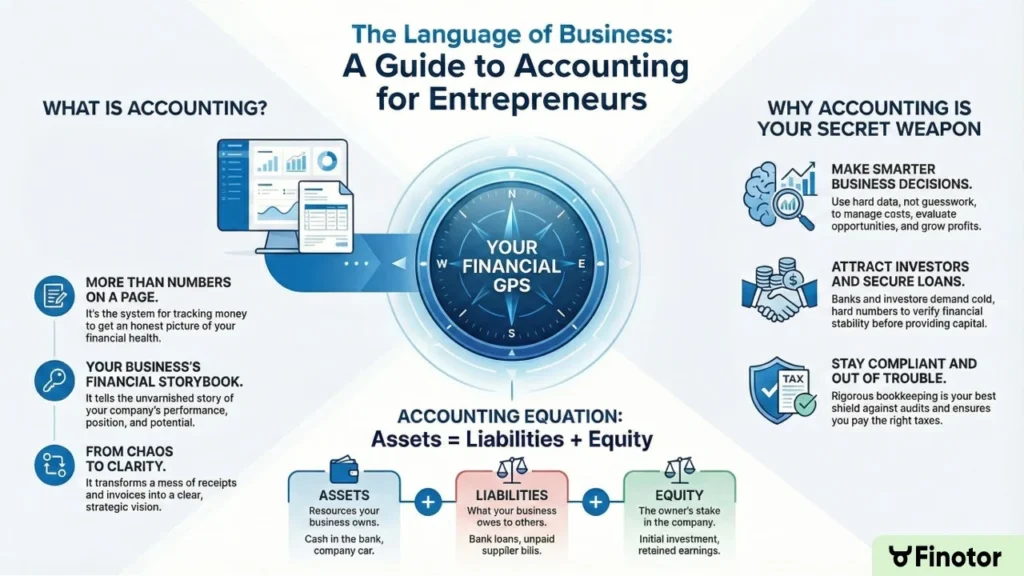
Let’s Get Straight to It: What Is Accounting in Plain English?
More Than Just Numbers on a Page
At its simplest, a solid accounting definition is the process of tracking the money flowing in and out of your business. Think of it as the financial dashboard for your activity—tools like Finotor make this visualization effortless for entrepreneurs.
The real goal is to give you a brutal, honest image of your financial health. It is a system designed to record, classify, and summarize all financial transactions. This systematic tracking of a company’s finances ensures you know exactly where you stand at any moment.
In short, it’s like a regular health checkup for your business, but strictly for its wallet. 🩺
Think of It as Your Business’s Financial Storybook
You should view accounting as a narrative. Every transaction you make is a sentence. Every financial report becomes a chapter. Put them together, and they tell the unvarnished story of your company’s performance and position.
This isn’t just about boring archiving or compliance. It is about interpretation and understanding the plot.
Accounting is often called the ‘language of business’ because it translates complex financial activities into information that anyone, from owners to investors, can understand.
The Core Process: From Chaos to Clarity
The process always kicks off with the recording of transactions. From there, you sort that data into logical categories so it actually makes sense.
The objective is to transform that raw data into digestible financial reports. Think of the balance sheet, income statement, and cash flow. These documents are your financial GPS to avoid crashing.
Accounting transforms the absolute mess of receipts and invoices into a clear, strategic vision.
See more: Video – What is Accounting?
See the video on Youtuble: What is Accounting? – The Secret Weapon for Business Growth
Why should you actually care about accounting? 📈
Making smarter business decisions
Most people think the standard accounting definition is just boring paperwork. Wrong. It’s actually your secret weapon for making decisions without guessing. If you ignore the numbers, you’re basically driving blindfolded.
Imagine you want to hire a new dev or buy a fancy espresso machine. Your financial reports tell you if you can afford it or if it’ll sink you. That is the bedrock of any solid growth strategy.
You need hard data for things like:
- Evaluating staffing and payroll costs.
- Managing inventory levels effectively.
- Identifying new business opportunities.
- Maximizing profitability.
Understanding these mechanics is crucial for decision-making.
Keeping the tax man happy (and staying out of trouble)
Let’s be real, nobody wants an audit. Rigorous bookkeeping is your best shield against the IRS. It guarantees you pay exactly what you owe, not a penny more. This ensures total legal compliance so you sleep better.
Clean books mean zero panic during tax season. It also proves you have nothing to hide from regulatory bodies. Nobody likes nasty surprises, especially from the nalogovik 😉. You want them to stay bored.
You really need to start understanding accounting regulations and compliance.
Attracting investors and getting loans
Banks and VCs don’t care about your gut feeling. They won’t give you cash just because you have a “cool idea.” They demand to see the cold, hard numbers first.
External parties dig deep into your balance sheets. They are checking your financial stability to see if you’ll survive the year. If your accounts are messy, they walk away. It is that simple.
Think of solid accounting as your professional business card. It proves you’re a serious player. 🤝
The 5 Non-Negotiable Building-Blocks of Accounting
Okay, accounting is vital, we get it. But let’s cut through the noise. A practical accounting definition isn’t about boring paperwork; it’s about tracking five specific buckets that tell you if you are winning or losing. Let’s break them down.
The Core Accounting Equation
Here is the golden rule you cannot ignore: Assets = Liabilities + Equity. This formula is the bedrock of your entire financial system. It is a mathematical law that must always balance, otherwise, your books are simply wrong.
Think of it this way: everything your business has (assets) is funded by either what you owe (liabilities) or what you own (equity). Mastering this logic is one of the most basic accounting principles for any entrepreneur.
What You Own and What You Owe
First, let’s talk about Assets. These are the resources your company controls that hold real value. We are talking about cash in the bank, your inventory, or even that expensive espresso machine. Basically, it’s anything that puts money in your pocket later. 💰
Then you have Liabilities. This is the heavier part: everything your business owes to outsiders. It includes bank loans, unpaid vendor invoices, or salaries you haven’t processed yet. It represents the claims creditors have on your hard-earned stuff.
What’s Left Over and How You Make Money
Equity is what remains at the end of the day. It represents the residual interest in the assets after you subtract all the liabilities. If you sold everything and paid off every debt, this value belongs to you.
Revenue is the engine of your business. It is the cash flowing in from your main activities, like selling products or consulting fees. It’s the top-line number that everyone loves to see grow. 🚀
Finally, Expenses are the costs you eat to generate that revenue. Rent, marketing ads, or staff wages fall here. Using a platform like Finotor helps you track these costs so they don’t silently kill your profits.
| Element | Simple Definition | Example |
|---|---|---|
| Assets | Resources your business owns. | Cash in the bank, company car, computers. |
| Liabilities | What your business owes to others. | Bank loans, unpaid supplier bills. |
| Equity | The owner’s stake in the company. | Initial investment, retained earnings. |
| Revenue | Money earned from sales. | Coffee shop sales, consulting fees. |
| Expenses | Costs incurred to generate revenue. | Rent, salaries, coffee beans. |
Bookkeeping and Accounting: They’re Not Twins
Most entrepreneurs confuse these two terms, and honestly, you risk losing money if you don’t grasp the difference. Let’s clarify this once and for all, because mixing them up is a rookie mistake.
Bookkeeping: The Daily Record Keeper
Bookkeeping is purely administrative and transactional work. It involves systematically recording every single financial transaction daily. Think of it as collecting raw data. Basically, you are logging where money comes and goes.
This function acts as the bedrock of your business. A solid bookkeeper ensures every cent is traced and classified correctly. Without this accuracy, everything else fails. In short, understanding bookkeeping is the foundation of the entire process.
Accounting: The Strategic Analyst
Now, let’s look at the accounting definition regarding analysis. Accounting takes that bookkeeping data and analyzes it deeply. It is a subjective and interpretative process for your growth.
Your accountant prepares financial statements and analyzes performance trends. They build budgets to help you make smart moves. Their main role is to give meaning to the numbers and offer strategic advice.
Tools like Finotor can automate most bookkeeping tasks easily. This leaves you much more time for the high-value analysis. 🧠
An Easy Analogy: The Mechanic and the Race Engineer
Let’s use a car analogy to lock this in. The bookkeeper is like a mechanic who ensures all parts are present and assembled well. It is highly technical and precise work.
The accountant acts as the race engineer on the track. They analyze car data to tell the driver how to win the race. 🏎️
Bookkeeping records the financial transactions, while accounting interprets, classifies, analyzes, reports, and summarizes that financial data to provide strategic insights for business decisions.
The Main Flavors of Accounting (and Which One You Need)
Just like doctors have specialties, accounting has flavors. Many entrepreneurs ignore this distinction and lose control of their cash. Here is the accounting definition broken down into three main types so you know exactly what you are dealing with.
Financial Accounting: Telling Your Story to the World
Financial accounting focuses on people outside your business. It tracks transactions to build standard reports like the balance sheet. Investors and creditors use these to judge your health. It creates the financial scorecard everyone else sees.
This isn’t the Wild West, though. You must follow strict rules like GAAP or IFRS. This makes your reports comparable to others globally.
Basically, it is the ““official” public face of your company. Check this introduction to financial accounting.
Managerial Accounting: Your Internal Secret Weapon
Managerial accounting is purely for your eyes only. It helps leaders make smart operational decisions every day. You use it to fix pricing or cut waste. It turns data into actual strategy.
The best part is that there are no government rules here. Your reports can be anything useful, like budgets or sales forecasts. It is totally flexible.
This is your toolbox to pilot the company from the inside. 🎯
Cost and Tax Accounting: Specialized Tools
Cost accounting is a specific slice of the managerial pie. It drills down into calculating the production costs of a good or service. You need this to know if you are actually making money. It analyzes margins deeply.
Tax accounting is a whole different beast entirely. Its only goal is making sure the business respects fiscal laws. It focuses on transactions that affect your tax load and preparing declarations. You want to avoid penalties.
- Financial Accounting: For external users, highly regulated.
- Managerial Accounting: For internal decisions, very flexible.
- Tax Accounting: For the government, focused on compliance.
You should understand the difference between general and cost accounting.
Who’s Reading Your Financial Reports Anyway?
You aren’t doing all this grunt work for nothing. 🛑 Various people, both inside and outside your venture, are counting on this info to make big moves.
Inside the Business: You and Your Team
First off, the primary user is you, the owner! Management and managers use this data to pilot the company, set hard targets, and evaluate performance. Using a tool like Finotor helps you stay on track. 🚀
Don’t overlook your employees in this equation. The numbers help them understand the company’s health and the security of their jobs. It is a surprisingly powerful internal communication tool that keeps everyone aligned.
Outside the Business: The People With the Money
Then we have the external users. These are the folks who don’t work inside the building but have a serious financial stake in your success or failure.
Investors are watching like hawks to see if they will get a return on investment. Meanwhile, creditors and banks want to verify that you can actually repay your debts without defaulting. 💸
Here is who is watching your wallet:
- Investors (current and potential)
- Lenders (like banks)
- Suppliers (to assess credit risk)
- Customers (to ensure long-term viability)
Government and the Public
Government agencies are always in the loop. Tax authorities, like the IRS, are the most obvious ones. They utilize your reports to verify that you are paying the exact right amount of taxes. 🏛️
It goes beyond just taxes, though. Regulatory bodies, statistical agencies, and even the public might access your financial info for transparency. This is especially true if you are a listed company.
In Brief: Accounting is the language of business. It helps make decisions and is different from bookkeeping. To get a solid accounting definition and master your strategy, check these out:
Accounting is the secret sauce for your business growth, not just a boring chore. 🚀 By mastering these basics, you turn financial chaos into a clear strategy.
simplify the process Use Finotor to automate your finances and focus on what you love. Let’s grow! 📈
FAQ
What is the simplest definition of accounting?
In plain English, accounting is the process of tracking, recording, and analyzing your business’s financial transactions. Think of it as a health check for your company 🩺. It takes raw numbers—like sales and expenses—and turns them into a clear story about your financial position, helping you make smarter decisions for the future.
Is there really a difference between bookkeeping and accounting?
Yes, they are definitely different! Bookkeeping is the daily groundwork of recording transactions (the data entry). Accounting is the high-level analysis that interprets that data to give you strategic insights. While bookkeeping tells you what happened, accounting tells you why it matters. Tools like Finotor are great because they automate the bookkeeping, giving you instant access to the accounting insights you actually need. 🚀
What are the 5 main types of accounts I need to know?
To keep your finances organized, everything falls into five buckets: Assets (what you own), Liabilities (what you owe), Equity (the owner’s value), Revenue (money coming in), and Expenses (costs to run the business). Understanding how these interact is the key to reading your financial reports like a pro. 📊
What are the three absolute basics of accounting?
The entire system rests on three pillars known as the accounting equation: Assets = Liabilities + Equity. This fundamental rule ensures your books are always balanced. It simply means that everything your business owns (assets) is funded either by borrowing money (liabilities) or by your own investment (equity). ⚖️
What are the typical steps in the accounting cycle?
The accounting process, or “cycle,” generally involves about 7 steps: identifying transactions, recording them in journals, posting to the general ledger, running a trial balance, making adjustments, generating financial statements, and finally closing the books. It sounds like a lot of work, but modern solutions like Finotor streamline these steps so you don’t have to do them manually! 🔄