
Key Takeaways:
– Double-entry bookkeeping is a system where every financial transaction is recorded in at least two accounts simultaneously — one debit and one credit — so that the books always balance.
– The accounting equation (Assets = Liabilities + Equity) is the mathematical backbone of the system. Every transaction maintains this equilibrium without exception.
– Debits are not deposits and credits are not income. Debit simply means the left side of a ledger account; credit means the right side. Whether a debit increases or decreases an account depends on the account type.
– The trial balance is the built-in error detection mechanism — if total debits do not equal total credits, something is wrong and the system tells you immediately.
– Finotor handles double-entry mechanics automatically behind the scenes — you categorise transactions, the platform ensures every debit has a matching credit, and your financial statements are always ready.
When people hear “double-entry bookkeeping”, they often imagine a room full of Victorian clerks scratching numbers into enormous leather-bound ledgers. The reality in 2026 is rather different — modern accounting software handles the mechanics automatically. But understanding the logic of double-entry bookkeeping remains one of the most valuable things a business owner or financial professional can invest time in, because it is the conceptual framework behind every financial report, every tax return, and every business valuation ever produced.
This guide from Finotor explains double-entry bookkeeping from first principles — what it is, why it works the way it does, and how to apply it to real business transactions — without the jargon and without the assumptions of prior accounting knowledge.
1. Why double-entry bookkeeping is the backbone of your business 🏛️
1.1. Moving beyond the simplicity of single-entry systems
To understand why double-entry bookkeeping exists, it helps to understand what it replaced — and why that predecessor was inadequate for anything beyond the simplest financial activity.
Single-entry bookkeeping is essentially a running cash log. You received EUR 500 — record it. You paid EUR 80 — record it. The net position tells you how much cash you have. It is simple, fast, and completely sufficient for a person managing their own finances.
For a business, however, single-entry breaks down quickly:
- ❌ It only tracks cash — not what you own or owe. A business that owns EUR 50,000 of equipment, is owed EUR 15,000 by clients, and owes EUR 30,000 to a bank cannot express any of this in a single-entry system.
- ❌ It has no built-in error detection. If you enter a figure incorrectly, the log simply accepts it. There is no mechanism to tell you something is wrong.
- ❌ It cannot produce financial statements. A Balance Sheet requires data on assets, liabilities, and equity — none of which single-entry captures. A Profit and Loss statement requires the distinction between operating income and capital transactions — which single-entry conflates.
- ❌ It is an open invitation to fraud. Without a dual record of every transaction, money can leave a business without any corresponding entry that should offset it.
Double-entry bookkeeping solves all of these problems simultaneously by recording not just what happened to your cash, but what happened to every element of your financial position as a result of every transaction. It tracks what you own (assets), what you owe (liabilities), your net worth as a business (equity), your income (revenue), and your costs (expenses) — all in an interconnected system where every element checks every other. For a foundational overview of the broader accounting context, see: Getting started with basic accounting principles.
1.2. Mastering the fundamental accounting equation
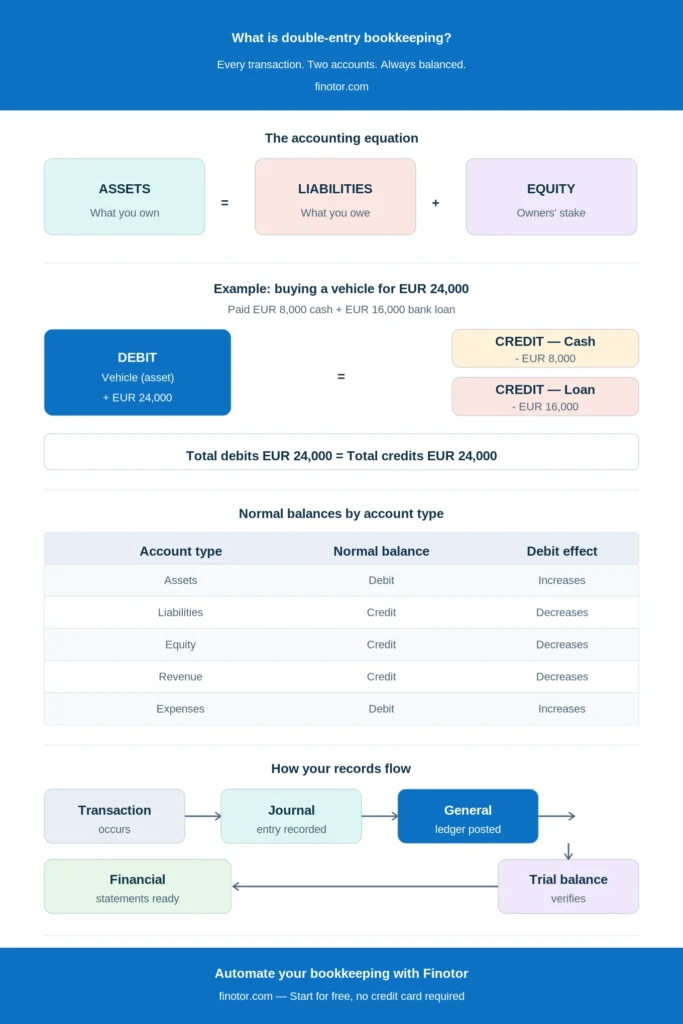
Everything in double-entry bookkeeping flows from a single equation:
Assets = Liabilities + Equity
This equation is not merely a formula — it is a statement of economic reality. It says that everything a business owns (assets) was financed either by borrowing (liabilities) or by the owners’ own investment and accumulated profits (equity). There is no third option. Every asset has a source of financing, and that source is either debt or equity.
Breaking down each element:
- 🏦 Assets — everything the business owns or is owed: cash, bank balances, accounts receivable, inventory, equipment, property, intellectual property
- 📋 Liabilities — everything the business owes to external parties: bank loans, accounts payable (supplier invoices unpaid), VAT payable, accrued expenses, deferred income
- 💼 Equity — the owners’ stake in the business: share capital invested, retained earnings accumulated from profitable operations, owner’s drawings subtracted
The equation always balances — and here is why:
Suppose you start a business by investing EUR 10,000 of your own money. Immediately: Assets (EUR 10,000 cash) = Liabilities (EUR 0) + Equity (EUR 10,000). The equation balances.
Now you borrow EUR 5,000 from a bank. Assets increase to EUR 15,000 (cash). Liabilities increase to EUR 5,000 (bank loan). Equity stays at EUR 10,000. EUR 15,000 = EUR 5,000 + EUR 10,000. Still balanced.
Now you buy EUR 3,000 of equipment. Cash decreases by EUR 3,000; equipment increases by EUR 3,000. Total assets remain EUR 15,000. The equation still balances. Every possible business transaction can be expressed as a movement within this equation that leaves it in balance. That is the genius of the system. See also: The 10 most important finance equations.
1.3. The duality principle and its impact on accuracy
The accounting equation gives us the framework. The duality principle gives us the recording mechanism that keeps it balanced.
The duality principle states: every financial transaction has two equal and opposite effects on the accounting equation. Value does not appear from nowhere and does not disappear — it moves from one account to another, or it creates an equal and offsetting change in two different accounts.
Three examples that illustrate the duality at work:
Example 1 — Paying a supplier invoice (EUR 400):
- Effect 1: Cash (asset) decreases by EUR 400
- Effect 2: Accounts payable (liability) decreases by EUR 400
- Net impact on equation: assets down EUR 400, liabilities down EUR 400 — equation remains balanced
Example 2 — Receiving payment from a client (EUR 1,200):
- Effect 1: Cash (asset) increases by EUR 1,200
- Effect 2: Accounts receivable (asset) decreases by EUR 1,200
- Net impact on equation: one asset increases, another decreases by the same amount — equation remains balanced
Example 3 — Earning revenue from a service (EUR 2,000, invoiced but not yet paid):
- Effect 1: Accounts receivable (asset) increases by EUR 2,000
- Effect 2: Revenue increases by EUR 2,000, which flows into retained earnings (equity)
- Net impact on equation: assets up EUR 2,000, equity up EUR 2,000 — equation remains balanced
This dual recording is what makes double-entry so powerful for error detection. If you forget one side of a transaction, the books immediately become unbalanced. The trial balance catches the omission instantly. No single-entry system can offer this guarantee.
“The duality principle is not an accounting convention — it is a law of financial physics. Value does not appear; it moves. Double-entry bookkeeping records both where it came from and where it went.”
2. Making sense of the debit and credit logic ⚖️
2.1. Visualising transactions with the classic T-account
The most common source of confusion in double-entry bookkeeping is the meaning of “debit” and “credit”. In everyday language, these words carry connotations — a credit card adds to what you owe; a bank credits your account when money arrives. In accounting, debit and credit are purely positional terms with no inherent positive or negative meaning.
The T-account is the visual tool that makes this clear. Every account in the general ledger can be represented as a T-shape:
| Debit (Dr) — Left side | Credit (Cr) — Right side |
|---|---|
| Entries recorded here increase debit-normal accounts
Entries recorded here decrease credit-normal accounts |
Entries recorded here increase credit-normal accounts
Entries recorded here decrease debit-normal accounts |
The key insight: debit simply means “left side” and credit simply means “right side”. Whether a debit entry increases or decreases the account balance depends entirely on what type of account it is — not on what the word “debit” means in common usage.
Every transaction in double-entry bookkeeping involves at least one debit entry and one credit entry, and the total of all debits must equal the total of all credits. This is the mechanism that keeps the accounting equation in balance.
2.2. Normal balances for assets, expenses, and liabilities
Each account type has a “normal balance” — the side (debit or credit) where increases are recorded, and where the account naturally carries a positive balance under normal circumstances. Understanding normal balances removes the confusion from almost every bookkeeping decision.
| Account type | Normal balance | A debit entry… | A credit entry… | Examples |
|---|---|---|---|---|
| Assets | Debit | Increases the account | Decreases the account | Cash, bank, receivables, equipment, inventory |
| Liabilities | Credit | Decreases the account | Increases the account | Bank loans, accounts payable, VAT payable, accruals |
| Equity | Credit | Decreases the account | Increases the account | Share capital, retained earnings, owner drawings (contra) |
| Revenue | Credit | Decreases the account | Increases the account | Sales revenue, service income, interest received |
| Expenses | Debit | Increases the account | Decreases the account | Salaries, rent, utilities, software subscriptions, bank charges |
The memory aid that makes this intuitive: assets and expenses both sit on the left side of the accounting equation (or flow into it) — so they have debit normal balances. Liabilities, equity, and revenue sit on the right side — so they have credit normal balances. When you increase something on the left, you debit it. When you increase something on the right, you credit it.
The golden rules of accounting (traditional formulation):
- For personal accounts (people and organisations): debit the receiver, credit the giver
- For real accounts (assets): debit what comes in, credit what goes out
- For nominal accounts (income and expenses): debit all expenses and losses, credit all income and gains
These rules and the normal balance table above are two ways of expressing exactly the same logic. Use whichever formulation makes more intuitive sense to you.
2.3. Leveraging Finotor to handle automated entries
Understanding the logic of debits and credits is genuinely valuable — it allows you to interpret your financial reports, catch errors, and have intelligent conversations with your accountant. But in 2026, you should not be manually calculating debit and credit entries for routine transactions. That is precisely what accounting software is designed to do.
Finotor handles the double-entry mechanics automatically behind every transaction you record:
- 🔗 Bank feed sync: when a transaction is imported from your bank, Finotor creates the corresponding double-entry journal automatically — debit cash for a receipt, credit cash for a payment, with the offsetting entry posted to the correct revenue or expense account based on your categorisation
- 🤖 AI categorisation: the platform learns your transaction patterns and suggests the correct account classification, applying the corresponding debit and credit entries without manual input
- 📊 Automatic trial balance: because every entry is double, the trial balance is always in equilibrium — the system will not accept a one-sided entry
- 🧾 Instant financial statements: because the underlying ledger is always balanced and current, your P&L and Balance Sheet are available in real time, not just at period end
The shift from manual ledger entries to intelligent accounting software is not a loss of control — it is a reallocation of your attention from mechanical processing to meaningful oversight. You review categorisations; the system handles the accounting equation. See: The role of technology in modern accounting.
3. Building your financial story through the ledger 📖
3.1. Transitioning from daily journals to the general ledger
In a complete double-entry system, transactions flow through two sequential stages before they become the financial reports that business owners and investors rely on. Understanding this flow clarifies why accounting records are structured the way they are.
Stage 1 — The Journal (Book of Prime Entry):
Every transaction is first recorded in a journal — a chronological list of financial events. Each journal entry specifies the date, the accounts affected, the amounts debited and credited, and a brief description. Journals are the raw, time-ordered record of everything that happened.
In practice, businesses maintain several specialised journals:
- 📥 Sales daybook: all sales invoices issued
- 📤 Purchases daybook: all supplier invoices received
- 💰 Cash receipts journal: all cash and bank receipts
- 💳 Cash payments journal: all cash and bank payments
- 📋 General journal: adjusting entries, corrections, and transactions that do not fit the specialised books
Stage 2 — The General Ledger (Nominal Ledger):
Journal entries are then “posted” to the general ledger — the master record where transactions are organised by account rather than by date. Where the journal answers “what happened on March 15th?”, the general ledger answers “what is the total balance of the Equipment account?” or “how much have we spent on rent this year?”
Each account in the general ledger accumulates all the debits and credits posted to it over the period. The net balance of each account — the difference between total debits and total credits — is the figure that will appear in your financial statements.
In modern accounting software like Finotor, this posting process is invisible — the software handles the journal and the ledger simultaneously when you record a transaction. But the underlying structure is identical to the manual process developed five centuries ago.
3.2. Using the trial balance as a safety net
The trial balance is a periodic listing of every account in the general ledger with its current balance, presented in two columns — one for debit balances and one for credit balances. Its purpose is verification: if the total of the debit column equals the total of the credit column, the books are arithmetically consistent with the double-entry rules.
Running a trial balance is the first step before preparing any financial statements — it confirms that the underlying ledger data is internally consistent before that data is assembled into reports.
What a balanced trial balance tells you:
- Every journal entry posted during the period has equal debits and credits
- The arithmetic of the ledger is internally consistent
- The books are ready for financial statement preparation
What a balanced trial balance does NOT tell you:
- That transactions have been posted to the correct accounts (a payment posted to the wrong expense account balances but is still wrong)
- That all transactions have been recorded (a completely omitted transaction leaves the trial balance balanced — but incomplete)
- That there are no fraudulent entries (a fictitious transaction recorded with equal debits and credits balances the trial balance perfectly)
Errors that an unbalanced trial balance reveals immediately:
- A journal entry with unequal debit and credit amounts
- A posting made to the debit side of one account without a corresponding credit posting
- An arithmetic error in calculating an account balance
- A transposition error that was made asymmetrically (e.g., EUR 1,890 debited but EUR 1,980 credited)
For more on how to identify and resolve trial balance discrepancies in practice, see our detailed guide: How to reconcile bank statements.
3.3. Turning raw data into professional financial statements
The general ledger balances, once verified by the trial balance, are the direct input to your two core financial statements. Understanding this connection demystifies what financial statements actually are — they are organised summaries of ledger account balances, not separately prepared documents.
The Income Statement (Profit and Loss):
- Takes all revenue account balances (credit normal) and all expense account balances (debit normal)
- Revenue minus expenses = net profit or loss for the period
- Covers a period of time (month, quarter, year) — not a single moment
- The net profit figure transfers to retained earnings in the equity section of the Balance Sheet
The Balance Sheet:
- Takes all asset account balances (debit normal), all liability account balances (credit normal), and all equity account balances (credit normal)
- Assets = Liabilities + Equity — the accounting equation, expressed as a report
- Captures a snapshot at a specific date — not a period
- Confirms the solvency and net worth of the business at the reporting date
The double-entry system guarantees that the Balance Sheet always balances — not because someone checks it manually, but because the underlying mechanics of every journal entry maintain the accounting equation in perpetual equilibrium. A Balance Sheet that does not balance is not a rounding error — it is evidence of a structural bookkeeping failure.
For a beginner-friendly walkthrough of both statements, see: Understanding financial statements — a beginner’s guide and Financial statements overview.
Finotor automates your financial records, reconciles your accounts, and gives you real-time visibility — all in one platform.
Start for free
Book a demo
4. Putting the system into practice for growth 🚀
4.1. Walkthrough of a typical equipment purchase transaction
Nothing clarifies double-entry mechanics faster than a concrete, multi-account example. Here is a transaction that most growing businesses encounter: purchasing a vehicle for EUR 24,000, paid partly in cash (EUR 8,000) and partly with a bank loan (EUR 16,000).
Step 1 — Identify the accounts affected:
- Vehicle (asset account) — the business now owns something new
- Cash / Bank account (asset account) — EUR 8,000 leaves the bank
- Bank loan payable (liability account) — the business now owes EUR 16,000
Step 2 — Apply the normal balance rules:
- Vehicle is an asset — increasing it means a debit entry
- Cash is an asset — decreasing it means a credit entry
- Bank loan payable is a liability — increasing it means a credit entry
Step 3 — Record the journal entry:
| Account | Account type | Debit (EUR) | Credit (EUR) |
|---|---|---|---|
| Vehicle | Asset | 24,000 | |
| Cash / Bank account | Asset | 8,000 | |
| Bank loan payable | Liability | 16,000 | |
| Total | 24,000 | 24,000 |
Step 4 — Verify the accounting equation:
- Before the transaction: assume Assets = EUR 100,000, Liabilities = EUR 40,000, Equity = EUR 60,000
- After the transaction: Assets = EUR 100,000 + EUR 24,000 (vehicle) – EUR 8,000 (cash paid) = EUR 116,000
- Liabilities = EUR 40,000 + EUR 16,000 (new loan) = EUR 56,000
- Equity = EUR 60,000 (unchanged)
- Check: EUR 116,000 = EUR 56,000 + EUR 60,000. Equation balanced. Entry correct.
This multi-account transaction — one debit, two credits — illustrates that double-entry does not require exactly one debit and one credit. It requires that the total debits equal the total credits. Any number of accounts can be involved, provided the totals balance.
4.2. Comparing British and American accounting perspectives
Students of accounting sometimes encounter two slightly different ways of teaching the debit and credit rules — often described as the “British” (traditional) and “American” (accounting equation) approaches. The underlying arithmetic is identical; the pedagogical framing differs.
| Dimension | British (Traditional) Approach | American (Equation) Approach |
|---|---|---|
| Core framework | Three golden rules (personal, real, nominal accounts) | Accounting equation (Assets = Liabilities + Equity) |
| Teaching method | Rules applied to account type (debit the receiver, credit the giver) | Normal balances derived from position in equation |
| Ledger layout | T-account format with Dr/Cr columns | T-account format with Dr/Cr columns (identical) |
| Result | Identical journal entries and financial statements | Identical journal entries and financial statements |
| Primary use today | UK, Ireland, Commonwealth countries, professional exams (ACA, ACCA) | US, Canada, most business school curricula globally |
If you have been taught one approach and encounter the other in a textbook or course, do not be confused. The journal entries you produce, the financial statements you generate, and the trial balance you check are identical under both systems. The difference is purely in how the rules are explained, not in what the rules are.
4.3. Why modern commerce relies on this 500-year-old logic
Double-entry bookkeeping was first codified in 1494 by the Italian friar and mathematician Luca Pacioli in his work Summa de Arithmetica, although the merchants of Venice and Genoa had been using the system for at least a century before that. The fact that this system, developed for Renaissance-era trading businesses, remains the unaltered foundation of every modern accounting standard — GAAP, IFRS, and every equivalent — is not coincidence.
Why the system has survived five centuries unchanged in its logic:
- 🔍 Fraud prevention by design: the self-balancing nature of double-entry makes it structurally difficult to remove value from a business without creating a corresponding entry that reveals the movement. This was important to Venetian merchants managing agents across trade routes — and it is equally important to a company managing remote employees or automated payment systems today.
- 📊 Complete financial picture: single-entry tells you about cash. Double-entry tells you about everything — what you own, what you owe, what you have earned, what you have spent, and what your net worth as a business is at any moment. No alternative system achieves this completeness.
- ⚖️ Universal language: because double-entry is the global standard, financial statements prepared under it are intelligible to any investor, lender, or regulator anywhere in the world. This universality has real economic value — it reduces the friction of raising capital, entering new markets, and attracting international partners.
- 🤖 Software compatibility: every accounting platform ever built — from the earliest spreadsheet macros to modern AI-driven systems like Finotor — is built on double-entry principles. Understanding the underlying logic makes you a more effective user of any financial tool, because you understand what the tool is doing and why.
“Luca Pacioli did not invent double-entry bookkeeping — he documented a system that merchants had already proven worked. The reason it has lasted 500 years is that it is genuinely the most accurate way humans have devised to record economic activity.”
For more on the integration of modern technology with these timeless principles, see: Accounting software for small business and Accounting for small business.
FAQ — What is double-entry bookkeeping?
What is the fundamental difference between single-entry and double-entry bookkeeping?
Single-entry bookkeeping records each transaction once — typically as either income or an expense in a running cash log. It tells you about cash movements but cannot track assets, liabilities, or equity. Double-entry bookkeeping records every transaction in at least two accounts simultaneously, maintaining the accounting equation (Assets = Liabilities + Equity) in permanent balance. It provides a complete picture of financial position, enables financial statement production, and includes a built-in error detection mechanism that single-entry entirely lacks.
Why must debits always equal credits?
Because every transaction represents a transfer of value — not a creation or destruction of it. When you pay for equipment with cash, the value moves from your cash account to your equipment account. The debit to Equipment equals the credit to Cash. The total economic value in the system is unchanged; only its form has changed. If debits did not equal credits, it would mean value had appeared from or disappeared into nowhere — which is impossible. The mathematical enforcer of this reality is the accounting equation: Assets = Liabilities + Equity.
How does double-entry bookkeeping help in identifying accounting errors?
Through the trial balance — a periodic listing of all account balances that confirms total debits equal total credits. If a journal entry is posted with an incorrect amount on one side, if an entry is posted to only one account, or if an arithmetic error is made in calculating an account balance, the trial balance will not balance and the discrepancy will be immediately visible. This makes double-entry substantially more self-correcting than any single-entry system, where errors can persist undetected indefinitely.
What are the golden rules of accounting regarding debits and credits?
The traditional British formulation gives three rules: for personal accounts (people and organisations), debit the receiver and credit the giver; for real accounts (tangible and intangible assets), debit what comes in and credit what goes out; for nominal accounts (income and expenses), debit all expenses and losses, credit all income and gains. The American equivalent uses normal balances: assets and expenses have debit normal balances (debits increase them); liabilities, equity, and revenue have credit normal balances (credits increase them). Both formulations produce identical journal entries.
Is double-entry bookkeeping mandatory for all types of businesses?
Legally, the requirement varies by jurisdiction and business structure. Sole traders and very small businesses in some countries may legally maintain single-entry records for tax purposes. However, any limited company, corporation, or business required to produce statutory financial statements is effectively required to use double-entry bookkeeping — because it is the only system capable of producing a compliant Balance Sheet and Income Statement. In practice, any business beyond the micro stage benefits so significantly from double-entry that the question of legal obligation rarely matters — the operational advantages make the choice obvious.
Finotor automates your financial records, reconciles your accounts, and gives you real-time visibility — all in one platform.
Start for free
Book a demo