Virtual CFO Services: What They Are, What They Cost & How to Choose
The role of Chief Financial Officer has undergone a fundamental transformation. For startups and SMEs, accessing high-level financial leadership no longer requires a full-time executive hire. Virtual CFO services now provide expert financial strategy, analytics, and operational oversight on a flexible, cost-effective basis—giving any size company the financial edge previously reserved for large corporations.
What is a Virtual CFO and what do they do?
A Virtual CFO is a remote service provider offering high-level financial strategy, systems analysis, and management expertise to businesses on a part-time or consultancy basis. This modern solution caters to startups, small and medium-sized enterprises (SMEs), and growing businesses that require expert financial advice but do not have the resources to employ a full-time CFO.
The responsibilities of a Virtual CFO extend well beyond bookkeeping and financial reporting. They encompass:
- Strategic financial planning and long-term forecasting
- Cash flow management and optimization
- Risk management, tax planning, and compliance oversight
- Budgeting and raising capital
- Financial reporting and KPI tracking
- Automation of financial systems and processes
In today’s business climate, CFOs are expected to be visionaries—contributing to the strategic direction of the company, forecasting future trends, driving growth initiatives, and providing key insights that shape strategic decisions. By leveraging financial data and predictive analytics, a Virtual CFO guides companies toward profitable ventures and away from precarious investments.
The benefits of outsourcing CFO functions
Outsourcing CFO functions can be transformative for startups and SMEs that require agile, professional financial oversight without the burden of a full-time hire.
Cost savings vs in-house CFO
An in-house CFO typically entails a full-time salary, benefits, and overhead costs such as office space and equipment. A Virtual CFO eliminates these fixed costs, offering flexible pricing options and reduced overhead.
| Factor | In-House CFO | Virtual CFO |
|---|---|---|
| Annual cost | Full salary + benefits + overhead | Flexible retainer or hourly |
| Scalability | Fixed headcount | Scale up or down as needed |
| Industry breadth | Single-company experience | Multi-client cross-industry expertise |
| Availability | Office hours | 24/7 with the right platform |
| Best for | Large enterprises | Startups, SMEs, fast-growing companies |
By freeing up capital, companies can reinvest in core business areas that fuel growth and innovation. Beyond cost, outsourcing allows business owners and management to refocus on core revenue-driving activities: strategic planning, product development, and market expansion.
Access to advanced analytics and reporting
Virtual CFOs leverage advanced analytics to transform raw data into actionable insights that drive business growth.
Key analytics capabilities include:
- Real-time financial dashboards for instant visibility
- Customized reporting aligned with strategic objectives
- KPI tracking and performance benchmarking
- Predictive models and scenario analysis
- AI-powered pattern recognition and anomaly detection
Machine learning algorithms can predict cash flow trends, identify financial anomalies, and provide deeper insights into financial performance—empowering businesses to make informed, data-driven decisions. Compliance with financial regulations and maintaining accuracy in financial statements are foundational requirements that Virtual CFOs actively manage.
Virtual CFO services costs: what to budget
Understanding the costs involved in Virtual CFO services is essential for aligning them with your financial strategy and evaluating potential return on investment.
Pricing models (hourly, retainer, project-based)
Virtual CFOs typically offer three main pricing models:
- Monthly retainers — Predictable costs with dedicated availability; ideal for ongoing financial oversight and consistent strategic guidance
- Hourly rates — Flexible and scalable based on intensity of work required; costs vary widely by complexity and CFO seniority
- Project-based fees — For specific, one-time tasks such as fundraising prep, audit support, system implementation, or M&A due diligence
| Factor | Impact on Price |
|---|---|
| Company size and complexity | Larger, more complex businesses require deeper oversight |
| Scope of services | Full CFO suite vs. specific advisory tasks |
| CFO experience level | Senior professionals with proven track records command higher fees |
| Industry sector | Regulated industries (finance, health, nonprofit) require specialized knowledge |
| Software and integrations | Additional cost for financial management tools like Finotor |
When budgeting, also account for complementary financial management software. Solutions like Finotor can work alongside a Virtual CFO to provide automated bookkeeping, bank reconciliations, and reporting—optimizing the full value of your CFO engagement.
ROI calculation framework
The ROI of a Virtual CFO extends well beyond a simple cost comparison. Consider three dimensions:
1. Financial and operational improvements: A Virtual CFO typically streamlines financial operations, enhances reporting accuracy, and drives better decision-making. Automating financial processes and introducing advanced analytics significantly reduce errors and improve efficiency—leading to healthier cash flow and a stronger bottom line.
2. Direct cost savings: Eliminating full-time salary, benefits, and employment overhead allows businesses to reallocate significant funds to growth areas. Additionally, efficiency gains from process improvements and financial management technology further amplify the ROI.
3. Long-term strategic value: A Virtual CFO can guide companies through critical transitions—mergers, acquisitions, or new market expansion. Their expertise in financial forecasting and risk management is invaluable for sustainable growth, ensuring every investment aligns with the company’s long-term objectives.
Integrating a Virtual CFO with your financial management tools
Technology is the cornerstone of effective Virtual CFO services. It enables seamless communication, real-time financial reporting, and strategic analysis. When combined with advanced financial management platforms, Virtual CFOs deliver more comprehensive services with greater efficiency and accuracy.
Core integration capabilities that amplify Virtual CFO effectiveness:
- Banking and credit card connections for real-time transaction import
- Payroll system integration for staff compensation tracking
- Payment platform connectivity (Stripe, WooCommerce) for automated reconciliation
- AI-driven analytics for pattern recognition, forecasting, and anomaly detection
- Automated invoice processing and expense approval workflows
- Cloud-based accessibility enabling remote collaboration across time zones
AI and machine learning technologies further amplify the Virtual CFO’s capabilities—automating routine tasks like data entry and transaction categorization so your CFO can focus on strategic initiatives. Predictive models provide actionable insights that assist in making informed business decisions, streamlining the entire financial decision-making process.
24/7 support is a significant advantage of Virtual CFO services. Financial challenges don’t respect office hours—whether it’s a cash flow question at midnight or an unforeseen complication on a holiday, your Virtual CFO and their tools should be continuously available.
How to find and select the right Virtual CFO
Finding the right Virtual CFO requires a structured approach. The decision impacts your company’s financial health, strategic direction, and operational efficiency.
Key criteria and red flags
What to look for:
- Strong financial expertise and relevant qualifications (CPA, CMA, MBA)
- Demonstrated experience in your specific industry
- A strategic mindset aligned with business growth goals
- Excellent communication skills—ability to translate complex financial data for non-financial teams
- Proven track record of improving financial performance in similar businesses
- Proficiency with modern financial software and AI-powered tools
Red flags to avoid:
- Inability to explain their methodology clearly
- No verifiable experience in your business size or sector
- Vague pricing structures or undisclosed fees
- Limited use of technology and automation
- No client references or measurable case studies
Selection process step by step
- Assess your financial needs — Evaluate the complexity of your transactions, data volume, reporting requirements, and level of oversight needed
- Define clear objectives — Set SMART goals (Specific, Measurable, Achievable, Relevant, Time-bound) for your financial management
- Research candidates or agencies — Prioritize those specialized in your industry; review experience, qualifications, and client testimonials
- Evaluate technical and financial acumen — Assess software proficiency, regulatory knowledge, and AI/ML capabilities
- Ensure cultural alignment — The right VFD should share your company’s vision and integrate seamlessly with your team
- Start with a pilot project — Test the engagement with a defined scope before committing to a long-term retainer
Industries that benefit most from Virtual CFO services include tech startups, e-commerce, manufacturing, professional services, and nonprofits—any sector requiring dynamic financial strategies to adapt to fast-changing markets.
How Finotor aligns with Virtual CFO services
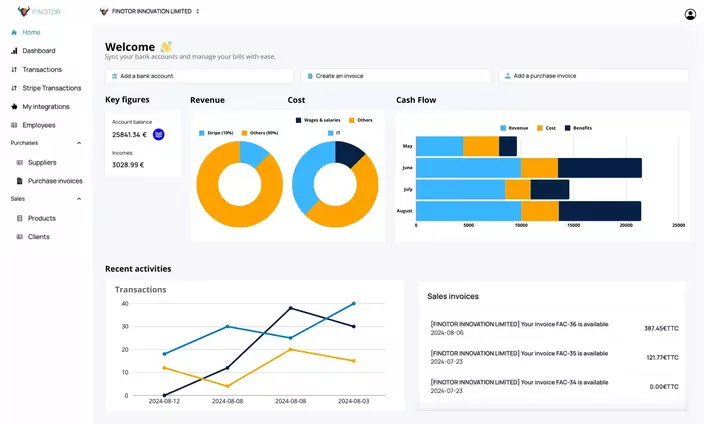
Finotor is designed as the ideal financial management backbone for businesses working with a Virtual CFO. Rather than requiring your CFO to manage disconnected tools, Finotor centralizes all financial operations—from automated bookkeeping to sophisticated reporting—in one integrated platform.
How Finotor amplifies your Virtual CFO’s impact:
- Automated bookkeeping — Eliminates manual data entry, freeing CFO time for high-value strategic work
- Real-time banking connections — Live transaction data for accurate, up-to-the-minute cash flow oversight
- AI-powered analytics — Pattern recognition, forecasting, and anomaly detection built in
- Seamless integrations — Stripe, WooCommerce, and banking systems connect automatically
- Custom financial reporting — Tailored dashboards and reports for boards, investors, and regulators
- 24/7 support — Continuous access to financial data and expert assistance whenever needed
By leveraging Finotor’s AI and machine learning capabilities, your Virtual CFO can provide insightful data analysis, automate tedious tasks, and offer more sophisticated financial strategies—handling a larger scope of advisory work without compromising quality or personalization.
Ready to elevate your financial management? Try Finotor for free and discover how it works alongside your Virtual CFO to give your business the financial leadership it deserves.
FAQ
What is a Virtual CFO?
A Virtual CFO (vCFO) is an outsourced financial expert who provides strategic financial guidance—including planning, forecasting, cash flow management, compliance, and reporting—to companies on a part-time or remote basis. It is ideal for businesses that need high-level financial management without the overhead of a full-time hire.
How does a Virtual CFO differ from a traditional in-house CFO?
A Virtual CFO offers similar strategic services to an in-house CFO but works on a flexible, part-time, or project basis. This makes the role significantly more cost-effective for SMEs and startups that don’t require—or can’t afford—a full-time executive.
What does a Virtual CFO typically cost?
Costs vary based on company size, service scope, and CFO experience. Pricing models include monthly retainers (most common), hourly rates, or project-based fees. Virtual CFOs are consistently less expensive than full-time hires when you factor in salary, benefits, and overhead.
What are the key responsibilities of a Virtual CFO?
Key responsibilities include financial strategy development, budgeting and forecasting, cash flow management and optimization, financial risk analysis and compliance, reporting for boards and investors, and advising on investments and growth opportunities.
What should I look for in a Virtual CFO?
Look for someone with strong financial expertise and relevant qualifications, experience in your industry, a strategic mindset for business growth, excellent communication skills, and a proven track record of improving financial performance in similar businesses.
How can a Virtual CFO benefit small businesses?
For small businesses, a Virtual CFO provides access to expert financial management at a fraction of the cost of a full-time CFO. They help optimize cash flow, improve profitability, manage debt, and support long-term strategic growth.
What industries benefit most from Virtual CFO services?
Any industry can benefit, but tech startups, e-commerce, manufacturing, professional services, and nonprofits see the greatest value—particularly those with complex financial needs, rapid growth, or regulatory requirements.
How does a Virtual CFO use technology in their role?
Modern Virtual CFOs leverage cloud-based financial tools, AI-powered analytics, and platforms like Finotor to provide real-time financial insights, automate reporting, manage cash flow, and enable remote collaboration with minimal manual effort.
Can a Virtual CFO help with financial reporting and compliance?
Yes. A Virtual CFO manages all aspects of financial reporting and ensures compliance with regulatory requirements—keeping financial statements accurate, current, and aligned with legal standards to reduce the risk of penalties.
What is the ROI of hiring a Virtual CFO?
ROI includes direct cost savings versus a full-time hire, efficiency gains from process improvements and automation, improved decision-making through better data, and long-term strategic value from guidance on growth, acquisitions, and risk management.
How does Finotor work with Virtual CFO services?
Finotor serves as the financial management backbone for Virtual CFO engagements—automating bookkeeping, reconciliations, and reporting so your CFO can focus on high-value strategic advisory work rather than data administration.
How can I find the right Virtual CFO for my business?
Start by assessing your specific financial needs, then research candidates with experience in your industry. Evaluate their technical skills, communication ability, and alignment with your strategic goals. Begin with a pilot project before committing to a long-term arrangement.
Can a Virtual CFO assist with business growth?
A Virtual CFO provides strategic financial advice that helps businesses make data-driven decisions for growth. From investment recommendations to scaling strategies, a Virtual CFO guides businesses toward sustainable growth by optimizing resources and improving profitability.