
Managing finances across complex supply chains requires more than traditional accounting tools. Modern businesses need integrated solutions that connect every aspect of their supply chain operations—from procurement and inventory management to shipping and final delivery—into a unified financial system like a supply chain accounting software.
What is supply chain accounting software?
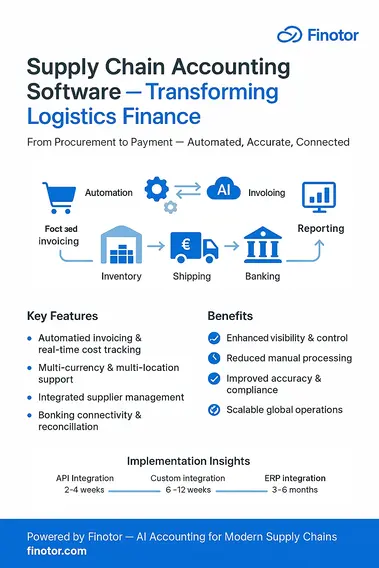
Supply chain accounting software
Supply chain accounting software provides comprehensive financial management specifically designed for businesses handling complex logistics operations, multi-location inventory, and extensive supplier networks. Unlike basic accounting tools that treat each transaction separately, these platforms integrate real-time financial tracking across your entire supply-chain ecosystem.
Traditional methods like spreadsheets or basic bookkeeping software fall short when managing multiple currencies, tracking inventory across locations, or handling the intricate cost structures of modern supply chains. Advanced platforms eliminate these limitations through automation and intelligent data processing.
- Learn more about cost accounting for a startup to optimize your operational costs.
- Explore best enterprise accounting software for scalable solutions.
Link to the video presentation page : Video – Supply chain accounting software
Core financial management features
Integrated invoicing and billing. Modern supply chain accounting platforms offer automated invoice generation that connects directly to your procurement, shipping, and delivery processes. This integration ensures accurate billing based on actual costs and delivery confirmations, reducing manual errors and accelerating your invoice-to-cash cycle.
Key invoicing capabilities include:
- Automatic invoice creation from purchase orders
- Real-time cost allocation across multiple projects
- Multi-currency billing support
- Integrated payment tracking and reminders (optimize your invoicing system)
Real-time expense tracking. Multi-dimensional expense tracking captures costs across transportation, warehousing, customs, handling fees, and supplier payments, providing complete visibility into operational expenses as they occur.
Banking and payment integration. Seamless banking connections enable automatic transaction importing, multi-currency payment processing, and real-time cash-flow monitoring. This eliminates manual data entry while keeping financial records aligned with bank activity.
AI-powered automation. Intelligent automation handles routine financial tasks like expense categorization, invoice matching, and reconciliation. Algorithms learn from your business patterns to improve accuracy over time while reducing manual processing.
- Discover AI: the silent revolution in business for automated financial workflows.
Advanced supply chain financial capabilities
Multi-location financial consolidation. Managing finances across multiple warehouses, distribution centers, or international locations requires sophisticated coordination. Advanced platforms provide consolidated financial reporting that aggregates data from all locations while maintaining detailed breakdowns for individual sites.
| Feature | Benefit | Application |
|---|---|---|
| Consolidated reporting | Unified financial view | Multi-location businesses |
| Location-specific tracking | Detailed cost analysis | Performance optimization |
| Currency conversion | Global operations support | International supply chains |
Inventory cost management. Real-time inventory valuation tracks the true cost of goods as they move through your supply chain, accounting for transportation, storage, handling, and other associated expenses. This comprehensive costing approach provides accurate profitability analysis at the product level (difference between general accounting and cost accounting).
Procurement and supplier management. Integrated procurement tracking manages purchase orders, supplier invoices, and payment schedules within your broader financial system—aligning procurement with budgets and cash-flow requirements.
Essential procurement features:
- Vendor performance analytics
- Purchase order automation
- Contract management integration
- Supplier payment scheduling
Freight and transportation accounting. Specialized features handle freight cost allocation, carrier invoicing, and international trade documentation requirements.
Types of supply chain accounting solutions
Cloud-native platforms. Cloud solutions offer scalable infrastructure, automatic updates, enhanced security, and integrations with other cloud tools (benefits of big data with an accounting software).
ERP-integrated systems. ERP integration connects supply chain accounting with broader operations, creating unified data flows and consistent financial information (best enterprise accounting software).
Industry-specific solutions. Platforms tailored for freight forwarding, warehousing, or manufacturing address unique financial requirements and compliance needs (accounting software for manufacturing industry).
Benefits over traditional accounting methods
Enhanced visibility and control. Real-time dashboards provide immediate insight into performance across your supply chain, enabling faster decisions, proactive issue resolution, and better forecasting.
Reduced manual processing. Automation removes time-consuming tasks like data entry, invoice processing, and reconciliation—freeing teams to focus on exceptions and analysis.
Key automation benefits:
- Faster processing times
- Reduced human errors
- Consistent data quality
- Lower operational costs
Improved accuracy and compliance. Data validation and audit trails reduce errors and support regulatory compliance. Built-in controls prevent duplicate payments, unauthorized transactions, and discrepancies (Finotor All-in-one AI-based Accounting Software).
Scalable operations. Flexible architecture supports growth—new locations, product lines, and higher transaction volumes—without full system replacement.
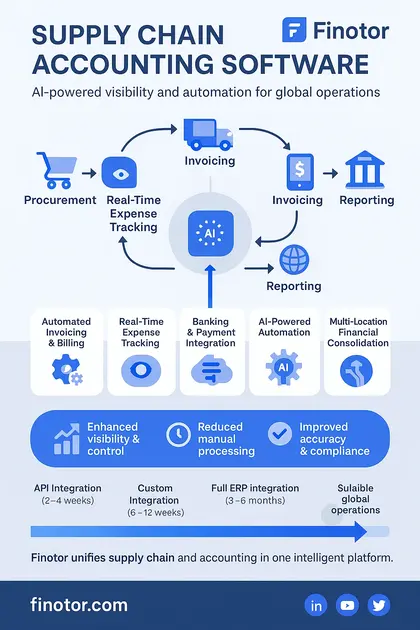
Supply chain accounting software with finotor with finotor
Implementation considerations
Integration requirements. Plan data migration and integrations with inventory management, CRM, and e-commerce tools (accounting for Shopify: best practices).
| Integration Type | Complexity | Timeline | Key Benefits |
|---|---|---|---|
| Basic API connections | Low | 2–4 weeks | Quick data sync |
| Custom integrations | Medium | 6–12 weeks | Tailored functionality |
| Full ERP integration | High | 3–6 months | Complete unification |
Security and access control. Role-based access, encryption, audit trails, and compliance certifications keep data secure while granting appropriate permissions.
Reporting and analytics. Customizable reports should cover standard financial statements and supply-chain metrics. Advanced analytics reveal trends, optimize costs, and improve efficiency.
Essential reporting features:
- Interactive dashboards
- Automated report scheduling
- Custom metric tracking
- Predictive analytics (Monte Carlo Simulation: From Chance to Finance)
Future-ready financial management
Modern supply chains demand advanced financial tools that go beyond traditional limitations. AI, predictive analytics, and automated workflows are now essential to maintain competitive advantage in complex global markets.
As supply chains evolve, integrated financial platforms provide the foundation for sustainable growth and operational efficiency—transforming finance from a reactive function into a strategic advantage (Finding Your Ideal Virtual Finance Director).
Frequently Asked Questions
What is supply chain accounting software?
Supply chain accounting software unifies procurement, inventory, shipping, and financial management into one platform. It provides real-time cost tracking, automated invoicing, and multi-location reporting for better visibility and decision-making.
How does supply chain accounting improve financial visibility?
By consolidating data from warehouses, suppliers, and banking systems, the software delivers real-time dashboards that show spending, profits, and cash-flow trends. This allows faster analysis and proactive control over operations.
What are the key benefits of automation in supply chain accounting?
Automation eliminates manual entry, reduces human error, and accelerates processes such as invoice matching, expense categorization, and reconciliation — improving accuracy, compliance, and scalability.
Can supply chain accounting software integrate with ERP or e-commerce tools?
Yes. Advanced solutions offer API and ERP integrations that sync data between your accounting, CRM, and e-commerce systems, creating a single source of truth for all financial activities.
How does Finotor support multi-location and multi-currency operations?
Finotor automates consolidation across global locations with real-time currency conversion and location-based reporting, helping international businesses maintain financial consistency and compliance.
What should businesses consider when implementing supply chain accounting software?
Plan for data migration, integration with existing systems, and role-based access control. Ensure the platform supports automated reporting, analytics, and secure user permissions to protect financial data.
Is AI used in modern supply chain accounting?
Yes. AI automates categorization, forecasting, and fraud detection while learning from transaction patterns to continuously improve financial accuracy and efficiency.