
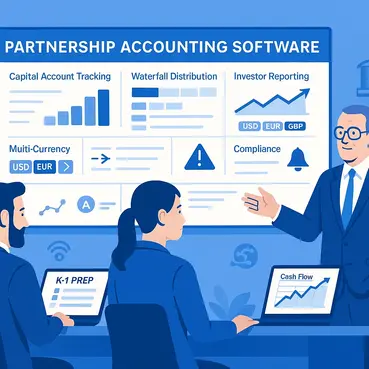
Partnership accounting presents unique challenges that traditional bookkeeping methods cannot handle effectively. From managing complex capital structures to tracking multiple investor distributions, partnerships require specialized software that goes far beyond basic spreadsheets or generic accounting tools.
Understanding partnership accounting complexities
Modern partnerships operate with intricate financial structures involving multiple asset classes, varying contribution schedules, and complex distribution formulas. Manual processes and basic tools quickly become inadequate when dealing with multi-tier partnerships, family limited partnerships, or investment funds with numerous stakeholders.
The challenges multiply when partnerships span multiple currencies, involve digital assets, or require frequent investor reporting. Traditional methods often lead to errors, compliance issues, and countless hours spent on manual reconciliation and report preparation.
Key challenges traditional methods cannot address
- Complex capital structure management across multiple investor classes
- Multi-currency transactions requiring real-time conversion tracking
- Automated distribution calculations based on varying partnership agreements
- Regulatory compliance reporting with strict deadline requirements
- Investor-specific performance reporting and communication needs
Essential features for partnership management
Automated capital account tracking forms the foundation of effective partnership accounting. This eliminates tedious manual calculations to maintain accurate partner equity balances and automatically adjusts for contributions, distributions, and allocated profits or losses.
Advanced invoicing capabilities tailored for partnerships handle complex billing structures—management fees, carried interest, and capital calls—while integrating these functions with partnership-specific accounting requirements.
| Feature | Traditional Methods | Modern Partnership Software |
|---|---|---|
| Capital account tracking | Manual spreadsheet updates | Real-time automated calculations |
| Distribution processing | Time-intensive manual work | Automated allocation formulas |
| Investor reporting | Days of preparation | Instant report generation |
| Compliance monitoring | Manual checklist tracking | Built-in regulatory alerts |
Comprehensive expense tracking is crucial across projects, properties, or vehicles. Automated categorization and allocation ensure accurate reporting at both the partnership and partner levels.
Banking connectivity synchronizes multiple accounts in real time, auto-categorizes transactions to partnership standards, and removes manual entry while preserving detailed records for tax reporting.
Technology-driven efficiency
AI-powered automation intelligently categorizes transactions, predicts cash-flow needs, and flags discrepancies before they become issues—reducing time to close and improving accuracy.
Real-time financial reporting provides instant access to performance metrics, capital balances, and investor-specific reports—without waiting for manual compilation.
Automation benefits
- Transaction categorization with machine-learning accuracy
- Predictive cash-flow modeling for better planning
- Automated reconciliations that reduce manual oversight
- Exception reporting for unusual transactions or patterns
- Intelligent document processing for faster data capture
Multi-currency support and complex ownership-structure management ensure the software can handle sophisticated, international, and multi-asset partnerships.
Specialized solutions for different partnership types
Private equity partnerships
Purpose-built lifecycle management from fundraising to final distributions, including carried-interest calculations, management-fee tracking, and investor-grade performance reporting.
Essential private equity features include:
- Waterfall distribution modeling with scenarios
- Secure limited-partner portals for communication
- Performance attribution across portfolio companies
- Capital call and distribution automation with notifications
Real estate partnerships
Property-level accounting tracks each asset’s performance while consolidating at the partnership level—handling depreciation, capital improvements, and property-specific distributions.
Family limited partnerships
Tools for managing complex family structures, gift and estate considerations, and simplified reporting for non-professional investors.
Family partnership requirements:
- Simplified reporting for family stakeholders
- Gift and estate tax assistance
- Multi-generational ownership tracking
- Educational resources for family members
Implementation and optimization
Migrating from legacy systems or manual processes requires careful planning and robust import capabilities. The ideal solution includes guided implementation and training to ensure a smooth transition.
Cloud-based architecture delivers scalability and anywhere access while meeting security requirements for sensitive financial data.
Extensive integrations connect with business systems, tax software, and investor portals—eliminating duplicate data entry and creating a seamless workflow.
| Phase | Duration | Key Activities |
|---|---|---|
| Data migration | 2–4 weeks | Historical data import and validation |
| System configuration | 1–2 weeks | Partnership structure setup |
| User training | 1 week | Staff onboarding and workflow training |
| Go-live support | 2 weeks | Monitoring and adjustment period |
Advanced reporting and compliance
Automated K-1 preparation streamlines one of the most time-consuming tasks—handling multi-state allocations and complex structures with accuracy.
Comprehensive audit trails and compliance reporting meet regulatory requirements and provide documentation for audits or investor due-diligence.
Compliance features
- Real-time regulatory update notifications
- Automated deadline tracking with alerts
- Document-retention policies with secure storage
- Audit-ready report generation with supporting documentation
- Multi-jurisdiction compliance monitoring
Moving beyond traditional limitations
While spreadsheets and basic tools may suffice for simple structures, partnerships need sophisticated functionality. Manual processes create bottlenecks, increase errors, and limit timely, accurate information for investors and stakeholders.
Modern partnership accounting software eliminates these limitations by automating complex calculations, ensuring compliance, and delivering the detailed reporting partnerships require.
Professional service integration
Many partnerships benefit from combining powerful software with professional accounting services. This hybrid approach pairs automation efficiency with expert oversight for complex issues.
The most effective solutions support collaboration by giving professional accountants secure access to the tools and data they need while maintaining transparency for management.
Finotor’s comprehensive platform addresses complex partnership requirements with an integrated solution that combines powerful automation and the flexibility to handle diverse structures. AI-driven capabilities streamline routine tasks while delivering the reporting and compliance features partnerships demand.
Whether managing a growing investment fund, a family limited partnership, or a complex real-estate venture, the right software turns partnership management from an administrative burden into a strategic advantage—supporting better decisions and stronger investor relationships.
Discover how modern partnership accounting technology can transform your operations and provide the efficiency, accuracy, and insights your partnership needs to thrive.