
Legal Accounting Software for Law Firms: Features, Compliance & Best Practices
Legal professionals require specialized accounting solutions that address the unique challenges of trust account management, billing compliance, and client fund handling. Traditional spreadsheets and basic bookkeeping tools often fall short of meeting the complex regulatory requirements and operational demands that law firms face daily.
Free legal accounting software
Understanding legal accounting software requirements
Legal accounting software differs significantly from standard business accounting tools. Law firms must manage client trust accounts, track billable hours accurately, handle retainer funds, and maintain strict compliance with state bar regulations. The software must provide detailed audit trails, automated trust account reconciliation, and specialized reporting capabilities that generic accounting solutions simply cannot deliver.
Modern legal accounting platforms integrate multiple functionalities into unified systems, eliminating the need for separate billing, time tracking, and financial management tools. This integration reduces errors, improves efficiency, and ensures consistent data across all financial operations. Explore how selecting the ideal accounting software for your firm can simplify these processes.
Comprehensive financial management features
Advanced invoicing capabilities form the foundation of effective legal accounting. The software should generate professional invoices automatically from tracked time entries, handle various billing arrangements including hourly, flat fee, and contingency structures, and provide customizable invoice templates that reflect your firm’s branding. Learn more about invoice automation tools.
Expense tracking functionality enables attorneys to capture billable expenses in real time, categorize costs appropriately, and seamlessly integrate expense data into client invoices. Mobile expense capture through receipt scanning eliminates manual data entry and reduces the risk of missed billable items.
Banking integration streamlines financial operations by automatically importing bank transactions, facilitating bank reconciliation processes, and providing real-time visibility into cash flow. This connectivity ensures accurate financial records while reducing manual data entry requirements. Finotor also allows you to connect Stripe and automate your accounting.
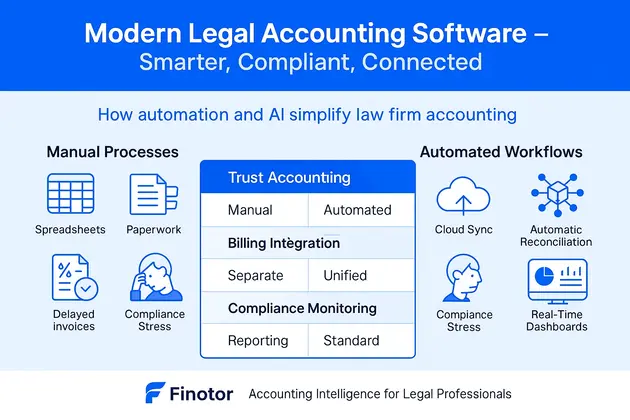
| Feature Category | Basic Solutions | Advanced Platforms |
|---|---|---|
| Trust accounting | Manual tracking | Automated reconciliation |
| Billing integration | Separate systems | Unified workflow |
| Compliance monitoring | Manual oversight | Real-time alerts |
| Reporting capabilities | Standard reports | Custom analytics |
AI-powered automation revolutionizes traditional accounting workflows by automatically categorizing transactions, identifying billable expenses, flagging potential compliance issues, and generating insights from financial data patterns. These intelligent features significantly reduce administrative overhead while improving accuracy. Discover AI accounting innovations that are shaping modern practices.
Trust account management and compliance
Trust accounting represents one of the most critical aspects of legal financial management. Proper trust account handling requires meticulous record-keeping, regular reconciliation, and adherence to specific state bar requirements. Specialized legal accounting software provides automated trust account reconciliation, detailed transaction tracking, and built-in compliance safeguards.
The platform maintains separate accounting for each client’s funds, tracks interest calculations where required, and generates the detailed reports necessary for regulatory compliance. Real-time monitoring alerts help prevent common trust account violations that can result in disciplinary action. Explore how legal center resources can support compliance best practices.
- Client fund segregation with automatic allocation
- Interest tracking for IOLTA accounts
- Audit trail maintenance with timestamped records
- Regulatory reporting for state bar requirements
- Balance monitoring with overdraft prevention
Financial reporting and analytics
Comprehensive financial reporting capabilities provide law firms with essential insights into their operational performance. Standard reports include profit and loss statements, balance sheets, cash flow analysis, and trust account summaries. Advanced analytics features track key performance indicators such as realization rates, collection efficiency, and matter profitability.
Customizable dashboards present critical financial metrics at a glance, enabling partners and administrators to make informed business decisions quickly. Automated report generation saves time while ensuring stakeholders receive regular financial updates.
Core reporting capabilities:
- Profit and loss statements with matter-level detail
- Balance sheets including trust account summaries
- Cash flow projections based on pending receivables
- Expense categorization by client and matter type
Performance analytics:
- Billing realization rates by attorney and practice area
- Collection efficiency metrics with aging analysis
- Matter profitability tracking with budget comparisons
- Time utilization reports for resource optimization
Integration and workflow optimization
Modern legal accounting solutions integrate seamlessly with existing practice management systems, email platforms, and document management tools. This connectivity creates efficient workflows where time entries, expenses, and client communications flow automatically into the accounting system.
Workflow automation reduces manual processes by automatically creating invoices from approved time entries, sending payment reminders to clients, and updating matter budgets based on actual costs and time invested. See how AI tools for business admin can further enhance workflow efficiency.
| Integration Type | Manual Process | Automated Workflow |
|---|---|---|
| Time tracking | Manual entry | Automatic sync |
| Document management | File separately | Linked records |
| Email communication | Copy manually | Auto-capture |
| Payment processing | Manual recording | Real-time updates |
Implementation and scalability
Effective legal accounting software grows with your practice, accommodating increasing transaction volumes, additional users, and expanded functionality requirements. Cloud-based solutions provide secure access from any location while maintaining data integrity and backup protection.
The implementation process should include data migration assistance, user training, and ongoing support to ensure smooth adoption across your firm. Intuitive interfaces minimize learning curves while comprehensive feature sets provide room for operational growth. Discover scalable accounting solutions designed for professional growth.
- User capacity expansion without performance degradation
- Data storage growth with automatic backup systems
- Feature enhancement through regular platform updates
- Security measures that scale with firm size and complexity
Making the right choice for your practice
When evaluating legal accounting solutions, consider your firm’s specific requirements including practice areas, client volume, regulatory obligations, and growth projections. The ideal platform combines robust financial management capabilities with legal-specific features while maintaining ease of use and reliable performance.
Finotor offers a comprehensive business and accounting solution designed to meet the evolving needs of professional service firms. The platform combines advanced financial management capabilities with intelligent automation, providing the tools necessary to streamline operations while maintaining compliance and profitability. Learn more about solutions for entrepreneurs and freelancers.
Explore how modern accounting technology can transform your firm’s financial management processes and support sustainable growth in today’s competitive legal marketplace.