
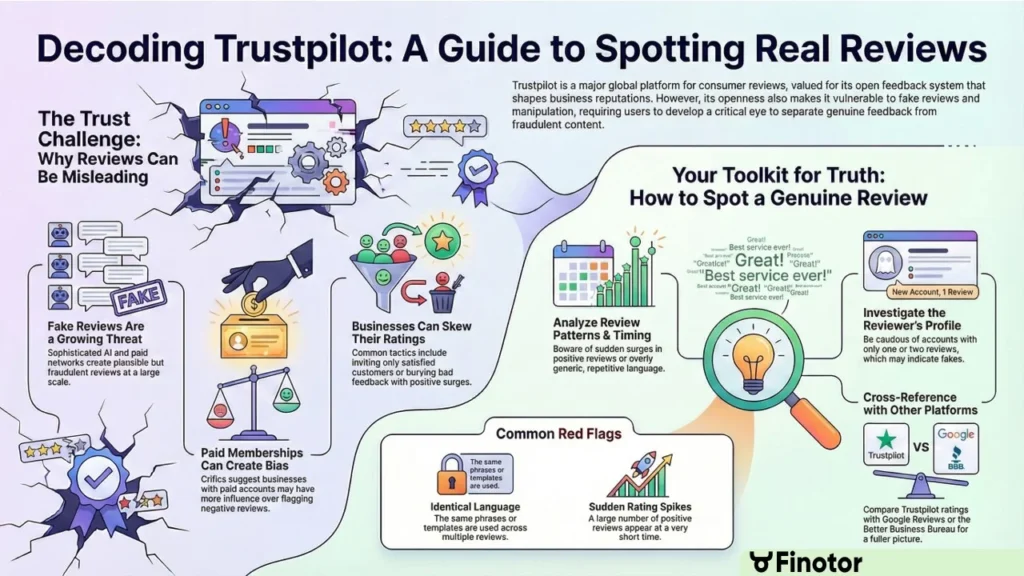
Key Points:
-
Trustpilot is a global reviews platform shaping consumer decision-making and business reputations, lauded for transparency and ease-of-use—but not immune to fake reviews or manipulation.
-
The core system relies on both open consumer feedback and business-driven review invitations, creating opportunities for authentic engagement or, conversely, strategic review stacking.
-
While detection mechanisms exist, new challenges like AI-generated review content and paid memberships complicate the landscape for genuine trust.
-
A critical, comparative approach that cross-references several reviews platforms delivers a more nuanced picture of business reliability.
-
Consumers and businesses alike must skillfully interpret review data and recognize patterns—balancing the usefulness of Trustpilot with the ever-present potential for distortion.
From search engine results to social media feeds, online reviews exert real power over our choices. At the heart of this phenomenon, Trustpilot has risen as a global reviews heavyweight, promising to champion consumer voices and to foster trust in business. But as the digital world grows ever more cunning—with AI churning out plausible yet synthetic opinions and businesses perfecting the art of reputation management—how much confidence can we truly place in Trustpilot reviews? This article peels back the curtain on one of the world’s most influential feedback platforms, dissecting its processes, its vulnerabilities, and its value for consumers and enterprises alike.
Consider Marie, an avid online shopper faced with a crucial decision: should she trust the sea of glowing reviews for a new wellness brand she’s never heard of? Meanwhile, for boutique businesses like LunaTech, mastering online perception can mean prosperity or peril. By delving into the mechanisms that power Trustpilot, examining genuine company case studies, and unpacking the increasingly sophisticated ecosystem of both honest and manipulated feedback, we reveal why critical thinking and digital literacy are more vital than ever. This deep dive is designed to empower consumers and demystify the platform for business owners—inviting everyone to look beyond the stars and challenge the surface before placing trust or making key decisions.
Understanding Trustpilot Reviews: How Reliable Are They for Consumers and Businesses?
What Is Trustpilot and How Does Its Review System Work?
Trustpilot is a global online platform dedicated to collecting and displaying user-generated reviews about businesses. Founded in Denmark in 2007, it now hosts millions of reviews spanning diverse industries, from e-commerce titans to service boutiques. The core idea behind Trustpilot’s platform is simple yet powerful: any consumer can share their experience as a review—both positive and negative—forming a publicly accessible reputation record.
Trustpilot reviews are organized by company, product, and occasionally by specific service, helping future customers make better-informed decisions. A pivotal feature is accessibility—reviewers don’t need prior approval (like purchase verification) to post. This open system invites broad participation but raises concerns about authenticity, as it can also become a playground for fake reviews.
The review process begins when consumers visit Trustpilot’s website, locate a business, and submit written feedback along with a star rating (typically one to five stars). In many cases, reviewers receive invitations directly from businesses post-transaction—a strategy known as review invitations. Companies can opt for free or paid membership tiers, each with different levels of engagement, analytics, and control over their review feeds.
The final output—the sea of reviews for each brand or service—is readily visible to anyone online, often dominating search results. But as we’ll see, what appears transparent can be nuanced, even manipulated, making it essential to look beneath the star ratings.
Trustpilot’s Mission, Transparency, and Business Interaction Features
What sets Trustpilot apart in the competitive world of online reviews is its stated mission: “to be a universal symbol of trust,” empowering consumers while providing businesses with actionable feedback loops. Trustpilot’s leadership repeatedly emphasizes accountability and transparency, asking companies to actively engage with customers—publicly responding to both praise and criticism.
Transparency features include public display of every review (within policy guidelines), a company score driven by customer star ratings, and real-time updates as new reviews arrive. A business account—especially at paid tiers—unlocks advanced analytics, review response templates, and tools for automated review invitations. These tools incentivize regular engagement, as businesses strive to demonstrate that they care about feedback, both glowing and scathing.
Consumers benefit too, as Trustpilot allows anyone to see if a business replies constructively to criticism or ignores negativity. Engagement is visible, and a healthy mix of responses—especially genuine attempts at resolution—often inspires more trust than a perfect, unblemished review biography.
This dynamic has led to the platform becoming a critical arena not only for customer service recovery but also for businesses to establish a public reputation rooted in ongoing conversations. But open dialogue comes with challenges: as user and business behaviors evolve, so does the challenge of maintaining authentic communication and safeguarding against manipulation.
Verification Processes and Review Invitation Methods on Trustpilot
Trustpilot’s open platform means anyone can leave reviews, but the company also implements processes to enhance data reliability and authenticity. Reviews can be either “organic” (left spontaneously by users) or “invited” (solicited by businesses after a verified transaction). The distinction is flagged for users, with invited reviews marked with a “Verified” badge if Trustpilot can confirm a legitimate purchase link.
Verification, while a step toward authenticity, is not foolproof. Some reviews—despite “Verified” labels—have come under scrutiny if companies invite only satisfied customers, skewing perceptions. Additionally, fake reviews are still a threat, as bad actors may exploit loopholes in the system, using temporary email addresses, bots, or other tactics to introduce unauthentic feedback.
Trustpilot walks a tightrope: trying to encourage as many voices as possible, while defending itself against review stuffing. The review invitation system can help improve response rates but is vulnerable to misuse if not managed ethically by businesses. In sectors with highly sensitive products—such as health, finance, and privacy—these verification issues become even more critical, with entire reputations and customer safety sometimes hanging in the balance.
Ultimately, understanding the nuances of review origin and verification on Trustpilot is crucial for both consumers and businesses who wish to distinguish between genuine trust signals and orchestrated review campaigns.
Assessing Trustpilot’s Trustworthiness: Challenges, Insights, and Practical Evaluation Tips
Real-World Company Examples: Positive Engagement and Reputation Management on Trustpilot
Successful businesses engage with Trustpilot actively, weaving it into their reputation management strategy. Take, for example, StellarMeds, a mid-sized online pharmacy. Initially facing criticism over delivery times, they set up a system to track Trustpilot reviews daily, empowering customer service reps to publicly respond within hours. Over six months, their trust score improved not just through invited reviews, but by resolving complaints transparently—turning disgruntled reviewers into advocates.
Contrast this with a case like FlashFit, a fitness equipment retailer. Determined to boost ratings for a new treadmill, the company overrelied on review invitations sent only to customers flagged as satisfied, essentially handicapping the system’s honesty. While their stars soared temporarily, savvy consumers noted the pattern and voiced skepticism, leading FlashFit to eventually recalibrate their approach and encourage more organic reviews.
Such stories illustrate a key insight: when businesses demonstrate a consistent and transparent response to all types of reviews—instead of gaming the system—they foster real trust and gain a strong reputational edge in the eyes of discerning consumers.
| Business Example | Engagement Tactics | Review Patterns | Perceived Trust |
|---|---|---|---|
| StellarMeds | Prompt public responses, follow-up offers | Mix of organic & invited, both positive and negative | High, transparent conflict resolution |
| FlashFit | Selective invitations, initial lack of negative response | Overabundance of positive reviews in bursts | Mixed, skepticism flagged by savvy readers |
These examples suggest a pattern: engaged, fair handling of reviews signals trustworthiness, while selective or defensive behavior can undermine consumer confidence.
Fake Reviews, Paid Manipulation, and AI-Generated Fraudulent Content on Trustpilot
A persistent challenge facing Trustpilot is the proliferation of fake reviews and review manipulation. Investigations over the past several years have documented networks of purchased feedback, ranging from five-star boosters for fledgling brands to malicious attacks on competitors. In 2025, a new and more insidious threat has emerged: AI-generated fake reviews, capable of weaving detailed, plausible stories in natural language that are difficult to detect.
Trustpilot has responded with enhanced detection algorithms, but studies continue to show that a non-trivial portion of reviews—especially in volatile sectors like finance, privacy, or emerging tech—are of dubious origin. Some businesses have been caught buying positive reviews or arranging for negative feedback to be posted about their rivals. The talking point: “All our reviews are 100% genuine,” has become something of a red flag.
Elite hackers and unscrupulous marketers now use generative AI to script fake reviews at scale, blending them artfully among organic feedback. These reviews, sometimes even complete with elaborate backstories and “verified” badges, present a serious challenge for both moderators and discerning consumers. As a result, savvy users must look past superficial positivity and interrogate the deeper authenticity of what they read.
Trustpilot’s Detection Mechanisms, Their Limitations, and Influences of Business-Paid Memberships
To combat fake reviews, Trustpilot employs a mix of algorithmic screening, human moderation, and community reporting. Suspicious patterns—burst posting, repeated text, or geographic oddities—are flagged for review. Businesses and users can also report suspect content directly. However, critics argue these mechanisms often lag behind more sophisticated fraud tactics, particularly as AI-generated reviews become harder to distinguish from real feedback.
A significant controversy surrounds the effect of Trustpilot‘s paid business memberships. Some consumers allege that companies with premium accounts can more easily flag negative reviews, request their temporary removal, or even resolve complaints offline in ways that encourage customers to edit or delete their critique. While Trustpilot insists all companies are held to the same standards, investigative journalists and watchdogs—like Which? and ProPublica—suggest otherwise. Such dynamics raise valid questions about the objectivity of reviews visible to the public.
Despite Trustpilot’s transparency efforts, there’s an inherent tension between monetizing the platform and ensuring unbiased moderation. Genuine brands are often frustrated when fake or malicious reviews linger, while others may benefit from system loopholes. For anyone relying on Trustpilot reviews, recognizing these limitations is vital to interpreting the real story behind the aggregated ratings.
Consumer Strategies for Spotting Suspicious Reviews and Analyzing Review Patterns
Digital literacy is more essential than ever when deciphering Trustpilot reviews. There are several tried-and-tested strategies to spot warning signs of inauthentic content:
-
Check review timing and patterns: Beware of review surges in short periods, especially when overwhelmingly positive.
-
Profile scrutiny: Investigate accounts with few or only single reviews, or whose histories are exclusively positive or negative about one company.
-
Language and tone analysis: Overly generic praise or enthusiastic superlatives (“amazing service, perfect product”) are hallmarks of fake reviews, as opposed to detailed, imperfect human commentary.
-
Diversity and specificity: Genuine review sets feature a mix of language, complaints, and specific anecdotes. Extreme uniformity may indicate manipulation.
-
Organic vs. invited: Aim for businesses with a balanced mix of organic and invited reviews for a fuller picture.
Consumers should also look for how companies address complaints: are they responding constructively or glossing over issues? Does the tone change over time? In many cases, authentic engagement—especially around negative reviews—signals genuine care and transparency.
| Red Flag | What to Look For |
|---|---|
| Identical language or phrases | Repeated use of templates across multiple reviews |
| Reviewer with 1–2 reviews only | May indicate fake, incentivized, or throwaway accounts |
| Sudden spikes in positive ratings | Often correlated with launches, campaigns, or reputation crises |
Remember: the goal is critical evaluation, not cynicism. Taking an extra minute to dig deeper can help separate credible voices from the noise and safeguard trust in purchase decisions.
Comparing Trustpilot with Other Platforms for a Holistic Business Reputation Assessment
While Trustpilot maintains high visibility in search engines and social media, wise consumers know that a single platform rarely tells the whole truth. Comparing Trustpilot reviews against those from other aggregators—such as Better Business Bureau (BBB), Google Reviews, Yelp, or independent forums—often uncovers valuable discrepancies or confirms patterns.
For example, an e-commerce brand may sport a 4.8-star average on Trustpilot but only achieve middling or poor ratings elsewhere, suggesting either targeted manipulation or differences in review solicitation. Furthermore, some platforms, like BBB, offer mediation avenues and display complaint records, which can be as revealing as five-star praise.
A holistic assessment might include:
-
Reading a cross-section of recent reviews on Trustpilot, BBB, Google, and niche platforms.
-
Comparing complaints, praise, and responses across sites to spot consistencies or troubling gaps.
-
Investigating the presence of verified transaction markers, business transparency, and responsiveness on each platform.
Diversifying sources helps consumers—and journalists, regulators, even businesses themselves—determine where genuine trustworthiness lies.
Balanced Conclusions: Using Trustpilot Effectively While Navigating Potential Pitfalls
Leveraging Trustpilot is ultimately a balancing act. On the positive side, it provides a public venue where businesses, especially smaller ones, can rapidly build credibility through honest engagement and high-quality service delivery. For consumers, the aggregation of thousands of reviews—warts and all—can illuminate real-world experiences otherwise hidden from marketing gloss.
Yet, the same strengths can become weaknesses: a few well-orchestrated fake reviews or a poorly managed response campaign can swing perceptions dramatically. For businesses, the temptation to “play the system” rather than earn trust can backfire if savvy consumers detect disingenuous tactics. Over time, transparency and consistent engagement prove the safest routes for credible reputation building.
In 2025’s crowded digital marketplace, Trustpilot is a tool—sometimes exposing, sometimes obfuscating the true nature of brands. Those able to wield it with intelligence, humility, and a dose of healthy skepticism are better positioned to make informed, confident choices.
How can I tell if a Trustpilot review is genuine or fake?
Look for detailed, balanced commentary rather than generic praise; check the reviewer’s history for more than just one or two feedbacks; identify unusual surges in reviews; and assess if the language or timing seems orchestrated. Pay attention to the presence of both positive and negative reviews and the specificity of the content.
Does Trustpilot remove negative reviews at the request of businesses?
Trustpilot will remove reviews if they violate its guidelines (such as offensive language or personal details), but negative opinions are usually permitted. However, there are criticisms that businesses with paid accounts may have more influence over moderation processes.
Can I trust the ‘Verified’ badge on Trustpilot reviews?
The ‘Verified’ badge indicates that a review came from a review invitation following a known transaction, but it does not absolutely guarantee authenticity. While helpful, savvy consumers should still look for review patterns and cross-reference with other sources.
Why do some businesses only display five-star reviews from Trustpilot on their websites?
Many businesses selectively embed only their best Trustpilot reviews to boost perceived trust. This selective curation can present a skewed impression, so always consult the full Trustpilot page and other review sites before making decisions.
Is Trustpilot better than the Better Business Bureau for checking business reputations?
Each platform offers unique insights: Trustpilot features more consumer-generated, global reviews, while the BBB emphasizes complaint records and mediation. Comparing both, along with other platforms, leads to a clearer, more holistic understanding of a company’s reputation.