
The essential to remember: AI transforms ecommerce accounting into a strategic advantage 🚀. By automating data entry, businesses cut error rates to 0.2% and gain real-time financial visibility. This shift boosts productivity significantly, allowing owners to focus on growth instead of paperwork. Discover our AI agent for Ecommerce.
Are you still drowning in spreadsheets while manual bookkeeping drains your profits and limits your growth potential? 📉 This guide reveals exactly how ecommerce accounting ai eliminates this chaos by automating your entire financial workflow in 2026. You will discover the specific tools that cut error rates to near zero and save your team hundreds of hours this year. 🚀
Why AI Is No Longer a Choice for Ecommerce Finances
The Chaos of Old-School Ecommerce Bookkeeping
Running a store isn’t just about sales; it is a logistical maze. You juggle Shopify and Amazon while drowning in hidden fees and tricky VAT rules. Tracking this manually is asking for a headache. 😫
This mess leads to costly mistakes and hours wasted on spreadsheets. Suddenly, bank reconciliation turns into a late-night nightmare you can’t wake up from. That is exactly why traditional ecommerce accounting can hurt a business. You lose money without even knowing where it went.
Sticking to this outdated method makes scaling your business in 2026 impossible. You need a change.
How Artificial Intelligence Cuts Through the Financial Noise
AI isn’t some distant sci-fi concept; it is a practical tool you can use today. It powers modern ecommerce accounting ai.
The technology automates invoice entry and sorts transactions before you even open your laptop. It handles complex reconciliations instantly. What used to take 5 minutes per invoice now drops to just 30 seconds. It works tirelessly in the background.
- Reduced error rates: from 3% down to 0.2%.
- Faster monthly closing: from 10 days down to just 3.
- Increased team satisfaction: from 65% to over 90%.
The Real-World Impact: More Than Just Numbers
The real win here is reclaiming your time, not just fixing spreadsheets. One service company actually saved over 300 hours a year by switching to this method. That is weeks of free time given back to the business owner.
“Companies automating their financial processes are seeing a 25% to 45% productivity jump in the first year. This isn’t a small tweak; it’s a structural advantage.”
Top AI Accounting Tools You Need to Know in 2026
The Integrators: Supercharging Your Current Setup
You don’t have to scrap your current setup to get smarter. Integrators layer directly onto software like QuickBooks, bringing ecommerce accounting ai power without a painful migration. It’s about boosting what you already own.
Take Webgility, for instance. It kills manual entry by syncing data between sales platforms and your books instantly. Xero adds muscle with automated bank reconciliation features. If you want a safety net, Botkeeper blends AI speed with human oversight to handle complex bookkeeping tasks.
The All-in-Ones: A Fresh Start for Your Finances
If you want a clean slate, look at “AI-Native” platforms. These aren’t just updated legacy tools; they are built around AI to replace traditional systems entirely. They fit perfectly for new businesses wanting total automation from day one.
Pennylane shines here, enabling real-time collaboration between you and your accountant. Then you have Digits. It learns how your specific business runs to provide 24/7 automation and financial reports that actually make sense.
A Quick Comparison of Leading AI Tools
Confused by the options? Here is a quick snapshot of the market leaders to help you decide. 📊
| Tool | Best For | Key AI Feature | Type |
|---|---|---|---|
| Webgility | Multi-channel sellers | E-commerce data sync | Integrator |
| Xero | SMEs & startups | Automated bank reconciliation | All-in-one |
| Zoho Books | Growing SMEs | End-to-end process automation | All-in-one |
| Botkeeper | Businesses needing support | AI + human expertise | Integrator / Service |
| Pennylane | Real-time collaboration | Accountant–business owner sync | All-in-one |
Practical AI Applications That Change the Game
Having the right tools is fine. But understanding where they truly change your daily life is even better. Let’s go beyond simple automation.
From Manual Data Entry to Real-Time Financial Visibility
Most e-commerce owners drive while looking in the rearview mirror. That ends now. AI shifts you from monthly reports to a live financial dashboard. This is the new standard for ecommerce accounting ai efficiency.
Take payment reconciliation as a concrete example. AI tools automatically match complex Stripe payout automations against your bank feed. It handles the messy mix of transaction fees, refunds, and timing delays instantly. This saves hours of manual spreadsheet work every single week.
Mastering Inventory and COGS with Predictive AI
Inventory management is often the hidden profit killer in online retail. Many businesses fly blind here. It is the single biggest drain on your working capital if mismanaged.
AI doesn’t just count boxes; it predicts risk. Systems can now forecast obsolescence before it hits your bottom line. More importantly, they calculate precise Cost of Goods Sold (COGS) by factoring in shipping fees in real-time. You finally know the true margin on every unit sold immediately. This is a massive advantage.
Smarter Sales Forecasting and Cash Flow Management
AI transforms your historical data into a reliable crystal ball for the future. It analyzes complex patterns to predict upcoming sales trends with surprising accuracy. 🔮
This predictive capability has direct implications for your cash flow survival. You stop guessing and start navigating with precision. It allows you to protect your bank balance proactively. Here is exactly what it does for you:
- Anticipate cash flow shortages before they happen.
- Identify your most profitable products and seasonal trends.
- Adjust inventory levels to meet predicted demand.
The Human Side of AI: Ethics, Compliance, and Your Future Role
Staying Compliant in the Age of AI
Data privacy is a serious game now 🛡️. With strict rules like RGPD (GDPR) and the incoming European AI Act, financial data handling is under a microscope. You can’t just ignore these regulations. Your business reputation depends on it.
Luckily, modern ecommerce accounting ai tools are built for this exact pressure. They lock down sensitive data automatically. Better yet, they can detect fraud in real-time, which is a massive win for your shop’s security. It stops suspicious activity before it hurts your wallet 🛑.
So, Is Your Accountant Becoming Obsolete?
Let’s answer the big question everyone asks. No, robots aren’t firing your CPA 📉. Instead, the job description is shifting from data entry to high-level strategy.
“AI handles the ‘what,’ freeing up human experts to focus on the ‘why’ and ‘what’s next.’ It’s not about replacement; it’s about strategic elevation.”
Your accountant becomes a growth partner 🤝. They use AI insights to guide your next move. It’s a vital debate on whether AI will replace accountants.
Your Next Step: The AI Agent
Honestly, AI isn’t just a “nice-to-have” anymore. It is the engine that drives a real competitive edge for your store 🚀. To see how an autonomous agent manages finances, check out our AI agent for Ecommerce. It changes how you handle daily books.
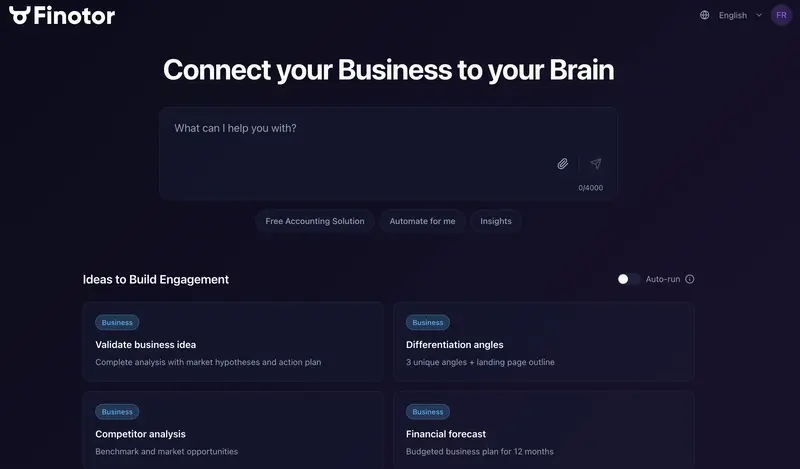
Connect Stripe, Paypal, Woocommerce, Shopify,… and you have your dedicated Agent AI.

Go to ai.finotor.com
Embracing AI for your ecommerce finances transforms how you operate. You stop drowning in data and start making strategic decisions. 🚀 Tools like Pennylane or automated agents give you a clear advantage. Don’t wait to modernize your accounting setup. Start automating today to secure your growth in 2026. 📈
FAQ
How does AI actually change daily e-commerce bookkeeping?
AI completely shifts your focus from data entry to data analysis. Instead of manually typing invoices or matching transactions, tools like Webgility or Xero automate these tasks instantly. It’s like having a virtual assistant working 24/7 to sync your sales channels with your bank. 🤖
This means you stop looking at the past and start managing your finances in real-time. You gain immediate visibility into your cash flow, allowing you to make faster decisions without waiting for the end-of-month closing.
Will using AI tools replace the need for a human accountant?
No, AI is not here to replace your accountant, but to elevate their role. The technology handles the repetitive “what” and “how” of data processing, which frees up your expert to focus on the “why.” 🧠
Your accountant becomes a strategic partner who interprets the data generated by AI. They guide you on tax optimization and growth strategies, rather than spending hours chasing missing receipts.
What is the difference between an “integrator” and an “all-in-one” AI tool?
Integrators are designed to supercharge your existing setup. For example, if you already use QuickBooks and Shopify, a tool like Webgility acts as a bridge to sync data between them automatically. It is perfect if you want to keep your current software but remove the manual work. 🚀
All-in-one platforms, like Pennylane or Zoho Books, are built to replace your old systems entirely. They handle everything from invoicing to banking and accounting in a single interface. This is often the best choice for new businesses or those looking for a fresh start.
Can AI really help with inventory management and COGS accuracy?
Absolutely, and this is a game-changer for e-commerce profitability. AI tools track inventory levels across multiple channels (like Amazon and eBay) in real-time to prevent overselling. 📦
More importantly, they calculate your Cost of Goods Sold (COGS) with extreme precision. By automatically factoring in shipping, customs, and platform fees, you get a clear picture of your true profit margin for every single product sold.